Sunday, September 11, 2022

Review: BBC documentary – Elizabeth: The Unseen Queen

On Friday, on BBC One, I watched Elizabeth: The Unseen Queen.

It’s a montage narrated by the late Queen that meanders through her personal film and photo archive about her life. It’s a beautiful, moving and intimate documentary. It explores her life as Queen through her own eyes and the personal snaps of her family. She seems quite 'normal' - but also very elegant and beautiful.

The background score is exquisite. The composer is David Schweitze.

I have uploaded a few stills from the documentary.


Prince Charles.


Saturday, September 10, 2022

King Charles III – The New Monarch

Accession council at St James’s Palace.
I enjoyed watching the fascinating ceremony in the Privy Council on the proclamation of the new King. It harks back to the Stuarts; a piece of living history. A functioning Royal Family is part of the rich tapestry of historic ceremonies and events.

The King’s first address to the nation was eloquent and moving (BBC News). Particularly admirable given that he’d delivered it after having lost both his parents in a relatively short period of time. The special mention of Harry and Megan was sweet and conciliatory. 

He has inherited an awesome responsibility as his reign, particularly in light of the challenges our nation is facing.

Long Live King Charles III.

Friday, September 9, 2022

On the passing of Queen Elizabeth II

Queen Elizabeth II by Pietro Annigoni.
What a sad day.

An icon of world history has just died. I must admit that the news of her passing did make me tear up a little – despite ofc not knowing her. She was a remarkable lady who had a profound impact on our nation and the world.

It’s a mark of how well she reigned – despite an age of monarchies being uprooted and republics replacing them – that her passing has touched so many people with many beautiful gestures and tributes from across the world. 

The Eiffel Tower had gone dark, Rio de Janeiro’s Christ the Redeemer has been lit up in the colours of the Union Jack, the Sydney Opera House, American flags were lowered at half-mast at all American embassies.

I have known of no other passing which has had such a marked worldwide effect.

Our late Queen embodied the true essence of the Crown. The incarnation of Walter Bagehot’s characterisation of the “dignified”. Despite her personal life and family matters being covered and heavily scrutinised by the media, she maintained her air of dignity and respect. The Queen tied the nation to its heritage, values, and history. Thus, as a beacon of stability and continuity, she united it.

It was fitting that Her Majesty greeted her new Premier a day before her passing. Her sense of duty undiminished even towards her final hours. As ever, she put the public first and simply got on with her duty. I have read that she was the most photographed person of all time.

An amazing lady.

Wednesday, September 7, 2022

Mikhail Gorbachev – an overblown legacy

On Tuesday August 31, 2022, Mikhail Gorbachev died aged 91.

I was born the year before the fall of the Berlin wall. For me, the death of Gorbachev attests to the freshness of the Soviet Union’s disintegration (and the subsequent birth of the modern Russian Federation).

Putin paying tribute to Gorbachev.

✲✲✲

Contrary to popular belief, the Soviet Union was not a communist state. It was a socialist state. As per Marxist-Leninism, the official ideology of the Soviet Union was that communism would emerge after socialism. The Soviet Union was in the process of strengthening socialism to establish communism. By the late 80s, the erstwhile approach was yielding nothing. Democracy and glasnost were tools that the last General Secretary hoped would strengthen the USSR, the Communist Party and “socialism” – as opposed to confronting them.

Much of Gorbachev’s legacy – as the unlucky warden – has the ring of Prometheus to it. But Prometheus acted deliberately, consciously; and was subsequently punished for his actions. 

Gorbachev’s reforms did not intentionally collapse the USSR. Gorbachev was always intent on bolstering the Union in some “reformed” shape under some commensurate socialist economic system. It became a comedy of errors. 

Gorbachev started the glasnost and perestroika as a genuine breakthrough but which utterly backfired. Like a decaying prison’s new chief warden setting up a system of democratic management and enfranchising prisoners to choose their own guards and alarm system. The failure was the dearth of required administrative skills to “westernise” the soviet state. The reforms began to pick apart the centralised economy without creating some alternative ‘institution’. Also, we shouldn’t forget socialism’s enduring systemic bug: it cannot cope with the complexity of dispersed knowledge in a developed nation. 

Nevertheless, the reforms unleashed political movements beyond Gorbachev’s control (which antagonised hard-line members of the nomenklatura), and the Union collapsed.

✲✲✲

On international relations, Gorbachev was promised that NATO would respect Russian security concerns. Instead, NATO expanded and installed military bases in Eastern Europe (the Union’s ex satellite states) and those military bases have thereafter been pointing at Russia. Russia was rebuffed from joining NATO when the Clinton administration harboured a more anti-Russian disposition than President Reagan. 

Today, the West celebrates Gorbachev as a hero. In some cases, that may be justified. He was responsible for the peaceful end of the Cold War. Nevertheless, if one adopts a more expansive purview, beyond the West, the breakup of the Soviet Union led to many deaths in the Warsaw Pact countries. Notably, Russia-Chechnya, Armenia-Azerbaijan, Russia-Georgia, Russia-Ukraine, Russia-Moldova. The Yugoslav conflicts arose mostly as a consequence of rising nationalism in Serbia and ethno-religious tensions; but it’s worth asking whether the lack of Soviet influence meant there was no power to keep them in check.

The post-Gorbachev crumbling state of poverty and crime was dire. The destruction and mendicancy of Russia was probably felt by Russians to have been met with celebration in the West. It probably ushered a strong FSB to take some charge of the state, fashioning an oligarchy, with the appointment of figures like Putin. 

Max Hastings writes that “Gorbachev failed, and a prominent legacy of his failure is the 21st-century tsardom created by Vladimir Putin.” To the extent that that is true, I suspect that the West has some blame in the rise of Putin in the humiliation of the post-cold war Russia when they could have been assisted and helped (and invited to be part of the NATO’s security aegis).

Nevertheless, he evinced considerable restraint in the use of violence in the implosion of the Soviet Union, particularly vis-à-vis Eastern Europe.

It’s striking that the USSR went from Stalin to Gorbachev in 32 years.

He deserved a legacy in the hands of someone better than Yeltsin as a successor.

Sunday, September 4, 2022

Turner at Tate Britain – Turner's Europe

This post is continuation of: Turner at Tate Britain – Turner's Britain

✲✲✲

Venice - Sunset, a Fisher by J.M.W. Turner (1845)

Venetian sunset.

What is really interesting about this painting is that it pins Venice onto a background where – as with the first light of dawn – the distinction between the sky (and clouds) and the river water – from the right perspective – can meld and interfuse. Sunsets – when viewed from a certain level – can create such a beautiful illusion. Hauntingly so.

I think Turner’s sunsets have a dreamlike ethereality. Diaphanous and abstract.

Through the mist Turner foments in his painting, the intensity of the brown-rusty hue alludes to the solid structures of life. The brushstrokes of stoney-grey create tenuous forms: as the wind in its diffusive speed, or as some splotch in the water. 

I think the sun can be just about be perceived on the right-hand side of the canvas from the epicentre of stillness. One can make out the Santa Maria della Salute against the blue skyline.

Beautiful.

✲✲✲

Venice - Noon by J.M.W. Turner (1845)

This painting forms a pair with the above Venice – Sunset, a Fisher. They both have similar tones, themes and colour palettes.

Both beautiful paintings of Venice.

✲✲✲

Riva degli Schiavone, Venice: Water Fête by J.M.W. Turner (1845)

Riva degli Schiavone.

According to the Tate, Turner’s painting had the following lines from Byron’s poem:

… and now, fair Italy!
Thou are the garden of the world…
Thy wreck a glory, and thy ruin graced
With an immaculate charm which cannot be defaced.

This painting is interesting. It doesn’t feel like Britain at all. It certainly has a Mediterranean quality. We don’t have trees quite like that in England.

In this painting, Turner’s sun illuminates from the right and the warmth of colours dissipate outwards. There’s a profusion of orange-marigold colours. Since this is a tribute to Roman architecture and elegance, the crumbling bridge as well as the mossed over hovels (at the right) attest to the classicism and elegance of ancient Rome.

And, as usual, Turner includes children and families that speak to a quality of innocence, purity, and arcadian charm.

It really is a lovely vista.

A closer examination

Nonchalantly sitting and chatting on a meadow overlooking a dilapidated breaking-up bridge. People seem oblivious to their surrounding beauty. The river slowly winding. Flowers surrounding the girls.

I was trying to determine whether that’s a cave of some kind and whether there is a faint outline of a person in a purple overcoat with a pointy hat on. It feels like that apparent individual is watching the group.

Music instruments on the floor, the boy dancing and his friend is playing a guitar or a lute. The larger group of ladies with their baskets of food, a loaf of bread, I think? This is a lovely scene that’s only amplified by the tranquillity of the river and surrounding forestry and vegetation.

✲✲✲

Heidelberg by J.M.W. Turner (1844)

Heidelberg

This painting is a marriage between Princess Elizabeth Stuart (eldest daughter of King James I) and Friedrich V. (Elector Palatine of the Rhine in the Holy Roman Empire). Heidelberg castle is behind them on the hill. According to the Tate, “their court was briefly famous for its extravagant entertainments.”

The royal couple are seated in the left-hand corner of the painting.

Beautiful radiant sun whose sunshine commingles with the surrounding clouds, snowy mountain peaks, a valley from which jubilant crowds are coming forth. It’s a lovely painting.

Details:

A man bowing before the royal court. Military paraphernalia at the side.

Castle that shimmers in the background.

Musical instruments and smiles all round.

✲✲✲

Caligula’s Palace and Bridge by J.M.W. Turner (1831)

I have to admit this was really breath-taking in the gallery. This is my favourite among the Europe gallery.

Although this painting is meant to invoke the decay of the glorious ancient Roman civilisation and Emperor Caligula, it captures a timeless beauty: the elegant columns that once held up a dome, the residual towers and fortification attest to a long-forgotten elegance, opulence and strength. 

The former palace seems to meld into the canopy and trees as though it was part of the natural world. The sun seems to originate from behind the Roman structures and radiates outwards. The illumination creates a marvellous shimmering line on the lake and spotlights the two children sitting on the rock.

There is a sense of nostalgia and wistfulness about the painting. The people of the painting don’t seem to notice the wondrous pensive beauty surrounding them.

Plus, I quite like Caligula.

Details:

Two children. One with an arm around the other. Two sweet goats approaching with a herd behind them. Sea and ships in the distant.

Four ladies dawdling in the lake. They seem to have two dogs near them. They’re at a leisurely pace. One of the girls is glancing at her leg. Perhaps she noticed something in the water. The scene makes you feel you can hear the giggles and laughter. 

Looks like a shepherd is herding a few straggling goats away from the lake and towards the field. He’s looking at the two boys as they chase a pair of goats.

The light gleams through the apertures and floods the environment. The Roman fortified buildings almost become one with the skyline otherwise they meld with surrounding vegetation. One with nature.

✲✲✲

Rouen: A View from the Left Bank in the Faubourg St-Sever by J.M.W. Turner (1827)
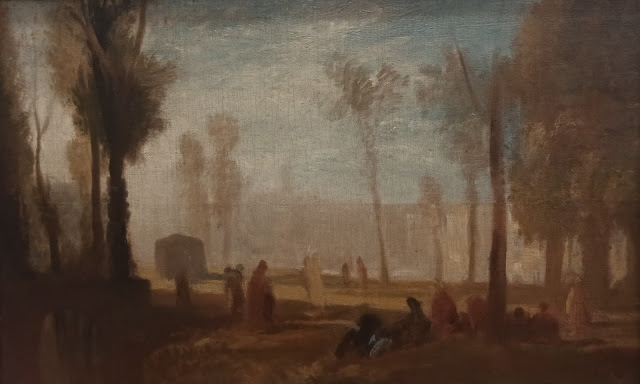

According to the Tate: “Turner based this view of Rouen on a sketch he made while travelling in France several years earlier.”

This is quite different to the rest. Turner’s characters in the painting are overshadowed and we don’t seem to have as much energy. 

✲✲✲

Dieppe: The Port from the Quai Henri IV by J.M.W. Turner (1827)

As with the above painting at Faubourg St-Sever, Turner doesn’t give us the warmth and opulence of the sun, so it feels a bit darker. But, it has the bustle of life and people going about their day. It’s hard to make out details but I don’t think we’re supposed to.

The structure of the bridge is beautiful. I think Turner likes bridges in his paintings too with a river flowing beneath it.