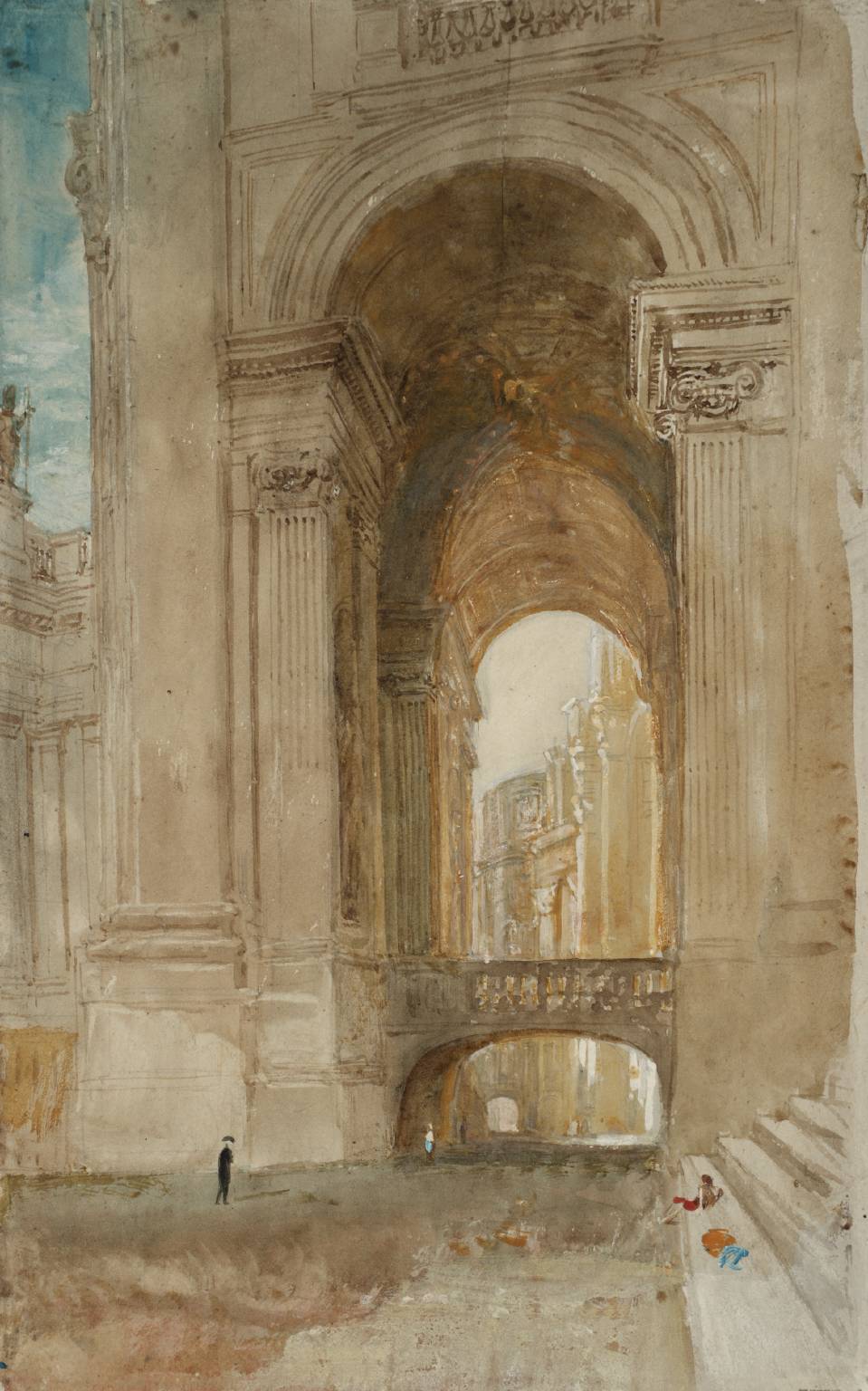
Yesterday, we visited St. Peter’s Basilica in Vatican City, Rome.
The experience of walking through St. Peter’s is the closest thing to being in heaven. It’s hard to convey the sheer immensity and majesty of St. Peter’s.
Walking through St. Peter’s, you can feel the Catholic Church of the 17th century conveying it’s belief that it, and only it, can lay claim as representatives of God on Earth. Especially, after the sack of Rome in the early 16th century and rapid expansion of the Reformation throughout Northern Europe.
The Catholic Church’s Counter-Reformation is the entire reason that St. Peter’s is so overwhelming: full of power and emotion, action, and meticulous detail. It’s the Baroque; and St. Peter’s is the acme of Baroque architecture: striking, golden, and extravagant with no reservations.
Below are some of the photos I took on the day.
✲✲✲
The Nave of St. Peter’s
Pure breathtaking magic.
The nave was decorated by Bernini who was commissioned by Pope Innocent 10th in 1645. But, it was designed and built mostly by Carlo Maderno. It’s full construction spanned over a hundred years and included contributions from architects like Bramante and Michelangelo.
I tried to take some photos with people to give an impression of height. It is 45-46 meters tall.
Sense of perspective.
✲✲✲
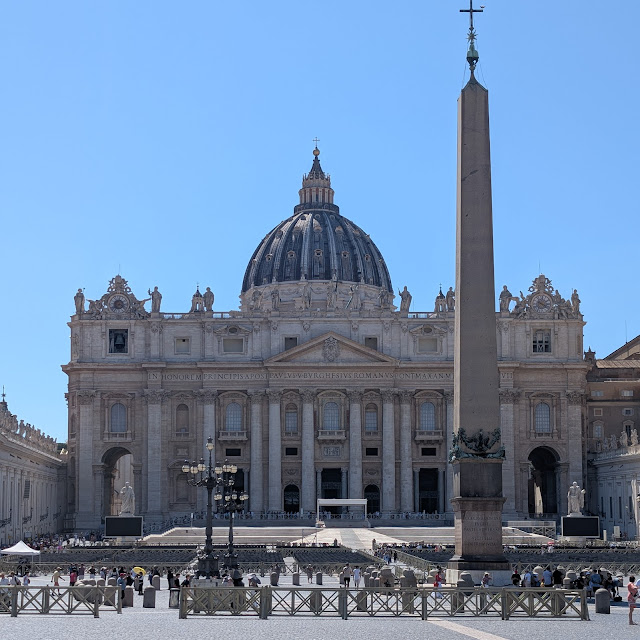
The façade of St. Peter’s Basilica
✲✲✲
Entry to the Basilica and climbing after the lift
We booked the “Dome with the lift” ticket. Fortunately, we managed to wizz past the crowds with our pre-booked tickets. It wasn’t nearly as crowded as I expected. (Probably because it wasn’t a weekend?) Nevertheless, despite getting the “lift” ticket, there were some serious steps to climb ... Upwards in tight and winding cases.
Entry. Not too busy.
Very hot. You can feel the heat!
Pillars. Visual grandeur.
The lift took us half way.
At this point, you had to climb up the remainder.
This is the staircase ...
✲✲✲
The view from the Dome of St. Peter’s
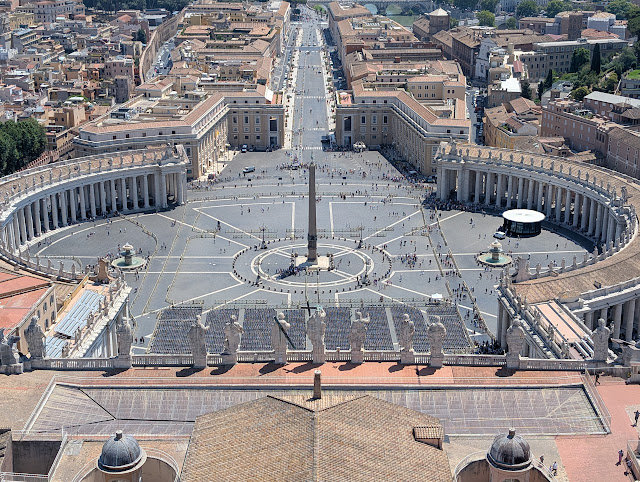
I love this view.
It’s like sitting on the clouds of heaven, and looking down.
So harmoniously designed, like a fully unified & complete composition.
View of Rome and the River Tiber.
This is the home of the Vatican Museum, Sistine Chapel, and
Pope’s personal chambers (the “Apostolic Palace”)
The Vatican Palace.
The Vatican’s main official government office.
I love the spacious gardens and greenery.
I was smiling all day. 😇
Arches on the Dome.
✲✲✲
St. Peter’s Baldachin and the Papal Altar
Bernini’s Baldachin is an ancient part of the Basilica (dating back to the construction of Constantine’s Basilica). It is the largest bronze sculpture of the Roman Baroque.
It is directly under the Dome and sits above St. Peter’s tomb.
Bernini’s Baldachin is under the main Dome.
Bronze canopy supported by four columns.
Sitting over a high marble plinth.
“Solomonic” twisting columns
(Inspired by those of the Temple of Solomon in Jerusalem).
✲✲✲
Bernini’s monumental “Cathedra Petri” (AKA: the Chair of St. Peter)
This was hard to photograph as I couldn’t get too close.
It is a gilded bronze sculpture enveloping the throne of St Peter (at the apse of the Basilica). The “throne” is a wooden chair which is considered a relic. Just like the shroud of Turin, it is unbelievable to imagine that that was the same chair of Saint Peter himself. Anyway, I couldn’t get too close so I couldn’t see it. It seems it’s been replaced now with a table and the relic in safe storage.
At any rate, just like the Baldachin over the main altar, the Cathedra Petri was designed by Bernini also. It has an immense visual and symbolic impact.
✲✲✲
The Domes (from within)

The main dome of St. Peter’s is adorned by mosaics
(YES!!, they’re mosaics which I was shocked to discover.
They’re not paintings or frescos which, wisely, deteriorate over time)
Latin inscription running around the base of the dome:
“You are Peter, and on this rock I will build my church ...”
There are many chapel domes which are smaller.
✲✲✲
The Pietà by Michelangelo Buonarroti
This beautiful statue is like the Mona Lisa – it’s too far away to really see it.
It sits 20 feet behind a glass wall. Some maniac previously tried to smash Mary’s face with a hammer.
So, as you can see, I couldn’t see it very well.
Not enough to discern the intricacies of human flesh and emotions between Mother and Son.
But I had (like everyone else) already seen so many images of Michelangelo’s Pieta, and I’m aware of the technical genius. Like Leonardo da Vinci’s St. Anne painting, he is able to cast a figure physically over another without it seeming awkward or malpositioned. Then, there’s the v. subtle emotion of tragedy of a mother losing her son in such a brutal and violent way. And, Michelangelo portrays her quiet strength and dignity as much as her love towards God and her son.
✲✲✲
The bronze statue of Saint Peter
Beautiful statute from the 5th century. Attributed to Arnolfo di Cambio.
As you can see from my photo, this is true!!
✲✲✲
Confessional

✲✲✲
The Tomb of Pope Alexander VII by Bernini (Bernini’s last major work)

Such drama & theatre.
The prayerful kneeling Pope Alexander VII: piety and virtue.
Billowing drapery of red marble pulled aside by the skeletal figure of Death.
This would have been the doorway to his tomb behind it (in which 2 men are chatting)
Bernini carved marble with a golden glistening skeleton.
Death holds the hourglass (memento mori) with delicate
long winged-feathers and an obscured & veiled face.
✲✲✲
Various statues

Holding a skull - a meditation on mortality.
Angel holding up a book.
Funerary Monument to Pope Benedict 14th.
Rising, to give a blessing.
Between wisdom and objectivity.
Funerary monument of Pope Gregory the 16th.
Allegorical figures of Knowledge (crowned) and Prudence.
Tomb of Pope Leo the 11th.
His statute and sarcophagus.
✲✲✲
The Arco delle Campane with the Swiss Guard

This view was painted by JMW Turner:
✲✲✲