Showing posts with label J.M.W. Turner. Show all posts

Wednesday, November 5, 2025

Whalers by J.M.W. Turner (1845)

Beautiful.

I came across this sublime painting at the Tate recently.

This painting is typical of Turner’s atmospheric style characteristic of his later years (died in 1851).

According to the Tate:

This painting shows the violence and danger of a whale hunt. Turner uses an arc of white paint and downwards strokes of grey – a flurry of rain and wind – to draw attention to a whaler dressed in white. He draws back a lance, aiming for a bleeding whale. Turner had read about whaling in Thomas Beale’s Natural History of the Sperm Whale (1839). Describing a hunt in Japanese waters, Beale talked of the whale as ‘a victim to the tyranny and selfishness’ but also the ‘great power’ of man. Turner was no doubt drawn to this tension – between the idea of whalers as heroes and murderers.

Interesting that you can barely make out the whale’s emergent head (adding to the unease?) ... and the whaling ship appears ghostly in the background.

I love the power & energy of Turner’s atmospheres - the terrifying ocean depths and man’s inherent vulnerability. A great contrast between the modesty and the cruelty of man.

Friday, April 18, 2025

JMW Turner’s 250th birthday - Pick your favourites of Britain’s greatest painter

Turner’s 250th birthday is celebrated in 2025.  Born 23 April.

Jackie Wullschläger (see below) has written a wonderful essay about why JMW Turner still excites and enthrals us. Comparing him to the post-impressionist artist; “Turner and Van Gogh painted what they imagined”. 

✲✲✲

Top 10 Turner paintings

1. Venice, Noon (1845)

2. Fishermen at Sea   (only 21 y/o when painted this)

3. Caligula’s Palace and Bridge (1831)

4. Norham Castle, Sunrise

5. Snow Storm: Hannibal and his Army Crossing the Alps

6. The Fighting Temeraire

7. Regulus

9. The Shipwreck

10. Frosty Morning

✲✲✲✲✲

Wullschläger writing in “Turner at 250 — why is he so beloved?” (FT):

The immediate answer is that the pictures are deeply pleasurable. As museums tend towards the conceptual and political, Turner guarantees painterly delightHis impact is instant and sensuous, his themes vast and inclusive: man and nature, present versus past, the rise and fall of empires. He engages and immerses.

Turner is theatrical, and also ambivalent — so we go on talking about him. His most political painting, “The Slave Ship”, subsumes man’s inhumanity to man into a tempest where, dashed with maimed bodies thrown overboard, a violent lurid ocean “burns like gold, and bathes like blood,” wrote Ruskin.

In painting, he did both. His idol, 17th-century painter Claude Lorrain, inspired his ambition, monumentality and grandeur. But coming of age during the French Revolution, Turner belongs to romanticism’s disorder. Smashing Claude’s classical equilibrium, he created pictures for a churning industrialising age, uncertain of its relationship with the natural world, thus newly fixated on landscape in painting and poetry — Turner’s peers are Constable (born 1776), Wordsworth (1770) and Coleridge (1772).

When Turner finally reached Italy in 1819, he was over 40, and responded not to its classical tropes (he was a hopeless figure painter) but to its radiant light. From then on, a golden luminosity suffused and heightened his paintings, not only of Italy — though his Venice views, converging shifting watery effects with themes of imperial decline, have a special elegiac beauty. 

The 19th-century age of materialism and realism, when artists from Constable to Monet insisted they painted their own visual experience, is fascinatingly bracketed by Turner and Van Gogh, who painted what they imaginedVan Gogh’s agitated spirals are descendants of Turner’s spinning vortices — a direct line felt if you go from the National Gallery’s Van Gogh: Poets and Lovers exhibition to the Clore.

Both Turner and Van Gogh were northern European artists who found their fullest expression under the Mediterranean sun, unprecedentedly raising the colour key to challenge what painting could be. Dazzling, consoling, beguiling, they brighten the winter and troubled times like rare northern lights.

Friday, May 3, 2024

J.M.W. Turner at the National Gallery

Below is a write-up of paintings of Turner’s at the National Gallery.

If asked about my desert island paintings — Turner would be included. I really love his work, and he’s so important in the history of art.

Why? Because the sublime 19th century romantic landscapes have the psychological depth and emotion that leave you with a sense of awe. Nature on a grand scale — massive skies, crashing waters, etc., and the sublime.

✲✲✲

The Fighting Temeraire by J.M.W. Turner (1839)

A beautiful & moving elegy. Slightly mournful but leavened with glory. 

Turner’s sunsets are magical.

A grand old navy sail-ship being scuttled by the new steam-age. The steam-propelled tug tows the old “Temeraire” up the River Thames to a ship-breaker’s yard in Rotherhithe, South London. There is also a white flag on the mast of the tug.

This painting depicts the final journey of the “Temeraire”, a famous warship sold by the Royal Navy in 1838. So, this was a real ship but probably not as Turner depicted it. The “Fighting” probably refers to her combat in the Napoleonic Wars and at the Battle of Trafalgar. Like us, in our obsolescence, when we too get old and are scuttled off.

Turner wonderfully contrasts the veteran ship against the blissful & radiant setting sun. Water seems to have no life other than to emphasis the sky, clouds, and smoke. Reflections in the water slow down the energy of the painting. The “Temeraire” also seems ghostly and ethereal while the tug boat is dark and powerful.

The sunset is on the same horizontal level as the Temeraire suggesting an approximation — and slightly obscured by the thick orange-smoke of that tugboat.

✲✲✲

Sun Rising through Vapour by J.M.W. Turner (1807)

Charming.

A warm, reposeful and quiet afternoon by the coast for a fishing community at the fore.

The calm is accentuated by the stillness of the sea.

 
Fish on the floor, a man pulling up his trousers.
A family having a heated discussion. 😊

Beautiful foggy London.

✲✲✲

Dido building Carthage by J.M.W. Turner (1815)

Queen Dido, the founder of Carthage, is on the left. 

In Virgil’s Aeneid, she was a Carthaginian founding myth, an equivalent to Remus and Romulus.

She is depicted examining the classical architecture of her city.

Turner was influenced by Claude Lorraine.

In Turner’s “The Decline of the Carthaginian Empire” at the Tate, we see this same painting (I think) after its construction, and its sun no longer in the ascendent.

 
Queen Dido on the left.

✲✲✲

Ulysses deriding Polyphemus by J.M.W. Turner (1829)

From Homer’s Odyssey with yet another motif of blazing sunrise/sunset.

Polyphemus is supposed to be in the mountains on the left and blinded by the light. He is the one-eyed giant son of Poseidon in Greek mythology and prevents Ulysses & his crew from returning home after the Trojan war.

I think it’s a striking and powerful visual masterpiece.

Beautiful ship with lots of sailors, and transparent sea nymphs swimming at the front of the ship

✲✲✲

Rain, Steam and Speed - The Great Western Railway by J.M.W. Turner (1844)

Wow. Love it.

This painting incredibly captures the spirit of change and modernism. The Steam Engine advancing across a bridge ploughing through the fog and rain — like the Industrial Revolution when railroads transformed the countryside.

Turner captures a beautiful mifty & foggy atmosphere in his paint. The landscape is bathed in a golden aureate, diffused light.

The locomotive is large, dark, unnatural in form, and even frightful in appearance. The modern railroad iron contrasts with the historic traditional bridge in the background from a different epoch. Like all sublime Romantic landscapes, it depicts nature as terrifying as well as beautiful.

Up close, it feels like impressionism.

✲✲✲

Dutch Boats in a Gale by J.M.W. Turner (1801)

Incredible.

Turner’s seascapes are the heroic.

The stormy weather is given an awesome force, and I love the rage in the waves — in their undulation and white crashing foam on the surface.

The enveloping storm clouds add to the foreboding scene.


Hanging on for dear life.

✲✲✲

ADDENDUM: Interesting article on “The Fighting Temeraire”:

Sunday, August 6, 2023

The JMW Turner art bequest and his legacy at the Tate and the National Gallery

I noticed an interesting article in The Daily Telegraph on the JMW Turner bequest.

In short, the family are complaining that the Tate and the National Gallery haven't complied with his wishes to have his work of 300 paintings and 30,000 sketches in a single repository. Many works are now either in storage or on loan.

I think this is an unfair criticism.

Firstly, I don't think there would be enough space to house all his works in some building on permanent display; and an art gallery shouldn't be an ASDA. Secondly, I think the job of a gallery is to rotate different works of art around different motif and discussions. There should be a rotation with some works being loaned out occasionally to other galleries around the world or going into archives to be refreshed later.

I think the Tate Britain does a great job managing his vast legacy.

I took the below photo at the end of July.

Friday, August 4, 2023

Turner gallery revisited - Part 4 - Turner's travels in Europe

Note: This blog is a continuation of my visit to the Turner gallery on the 26th of July.

This room in the gallery is about Europe as Turner saw and imagined it. The Revolutionary and Napoleonic Wars (1793-1815) prevented Turner from travelling freely. From 1817, Turner travelled to France, Belgium, Netherlands, Germany, Denmark, and especially Italy. 

It has only 5 paintings which I hadn’t covered before: Turner’s Europe.

✲✲✲

The Dogano, San Giorgio, Citella, from the Steps of the Europa by J.M.W. Turner (1842)

Turner, The Dogano, San Giorgio, Citella, from the Steps of the Europa

Spectacular. A billet-doux to Venice.

When Turner paints such an adorned vista, life itself becomes buoyed and suspended.

The tranquillity and serenity lent by the ever-so light fretting of the surface of the water. The imposing architecture (esp. San Giorgio Maggiore) and the gondolas allows for an ephemeral reflection which adds to the painting’s beguiling surface shape and geometry. As ever, the interaction between the skyline and the sea allows for them to interact & meld in Turner’s paintings.

Some details:


I really love this little sketch of someone oaring the gondola. A charming embellishment. And, even more sweetness: two little pups at the lower right-hand.

✲✲✲

The Bridge of Sighs by J.M.W. Turner (1840)

Turner, The Bridge of Sighs

One of Venice’s famous architectures, the Bridge of Sighs. It connects the Doge’s Palace and city’s prison.

As above, Turner gives such lovely architecture, dissolves them in a translucent reflection that life becomes a bit inverted. 

It’s really just beautiful. 

✲✲✲

The Opening of the Wallhalla by J.M.W. Turner (1843)

The Opening of the Wallhalla

This is supposed to be an homage to Walhalla by the River Danube.

Turner wanted to celebrate German history and culture after the defeat of Napoleon.

Once again, a very beautiful moving landscape. I really love classic bronzed rusty brownish-red colour and its interfusion with the atmosphere to conjur a paradise cloudland.

(A feast with music.)

✲✲✲

Santa Maria della Salute and the Dogana at the Entrance to the Grand Canal, Venice, at Sunset by J.M.W. Turner (1840)

This is from Turner’s sketchbook. There were a lot in the Tate, but I’ve picked two I think are interesting.

As usual, we get the hazy conditions, the beautiful reflections attesting to the city’s serenity, and the lovely radiance of yellow-orange behind the basilica. 

Lovely.

✲✲✲

Granville, Normandy by J.M.W. Turner (1826)

Again, what I find v. striking is just how modern Turner is; and yet there’s enough to make this quite beautiful.

✲✲✲

Caligula’s Palace and Bridge by J.M.W. Turner (1831)

I have covered this painting before

But I think it is so supreme. An exquisite and elegant rendering of decay, crumbling and deterioration. The beaming flood of light on the canvass is magical. It’s in my top 10 Turner paintings.

✲✲✲

Turner’s sketchbook (of Lake Geneva) by J.M.W. Turner (1841)

Turner gallery revisited - Part 3 - Sea Power

Note: This blog is a continuation of my visit to the Turner gallery on the 26th of July.

This room in the gallery is devoted to the sea (and Britain’s identity as an island, and its quondam unrivalled maritime power, especially around the Napoleonic era).

It has only 2 paintings which I hadn’t covered before: Turner’s Seascapes.

✲✲✲

Spithead: Two Captured Danish Ships Entering Portsmouth Harbour by J.M.W. Turner (1808)

This was painted by Turner - following Napoleon’s blockade - when he witnessed Danish ships arrive off the English coast.

I love the way Turner can paint a ship (the majesty of his ship’s mast and rudder etc.); and I also like the way he can capture the power of the choppy sea with its billowing, surging, and undulating mass of water and its interaction with the violent wind. Then, he manages to paint vulnerability and human fragility of the victims of the sea’s power.

I do love examining some of the details:

The facial anxiety, people gripping the boats, someone navigating the rudder, the wave’s crescendo towering just over the uppermost edge etc.

The force of the wind against the sail driving it forward crashing through the waves and the sea’s merciless severity.

✲✲✲

The Battle of Trafalgar, as seen from the Mizen Starboard Shrouds of the Victory by J.M.W. Turner (1806)

This epic captures the Battle of Trafalgar (21 October 1805).

The eye doesn’t know where to settle here. If you click the above painting, blogger expands the view. A panorama of widespread destruction and catastrophe. Billowing gunpowder charcoal smoke obnubilating our perception of the true reality. The warfare seems to have ended. Soldiers on the deck. 

The majesty of the ship is centre-most. The mast upright, powerful, and steely. Rising supremely from the keel to seize and control the awesome power of the wind. The mainmast’s flickering sail seems to dance in the wind. Although the French flag is dragged down and lowered (lower left); true victory pertains to the ocean and our maritime mastery.

As the Tate said, “celebration of victory over the French and Spanish navies mixed with grief over the death of naval hero Nelson.”

Pretty amazing painting.

Thursday, August 3, 2023

Turner gallery revisited - Part 2 - Turner and his critics

Note: This is a continuation of an earlier journal entry on The Turner gallery revisited. This part focuses - as per the Tate - on the reaction to Turners’ paintings when first exhibited. His works always drew a crowd; and over time his work divided opinion. I have focused on works that I haven’t already reviewed.

Apologies for the desultory nature of my posting. I plan to get back on track at some point. I’m usually juggling books, travelling, and also trying to have fun. Despite the ostensible Turner obsession on this blog; I will be branching out soon. These posts focus on works not covered when I visited in 2022.

✲✲✲

Frosty Morning by J.M.W. Turner (1813)

Beautiful.

Turner didn’t want to sell this painting. The Spectator said it captured the “true tone of nature, imitated to perfection”. Claude Monet described it as being painted with “wide-open eyes”.

I do love the crepuscular chill of this painting. The early rays of sunshine, the sweet little girl (Turner’s daughter) turning up her fur coat (as she turns to face the viewer), and one horse gently caressing the other which catches some patch of grass. It looks work is being done by a couple of lads on the pathway (and overseen by her father).

The net effect is an immersive and alluring vista of bucolic charm, the matutinal chill and stillness, an adorable girl and her townsfolk.

✲✲✲

Harvest Dinner, Kingston Bank by J.M.W. Turner (1809)

As per Tate, Painting “much admired by JS Cotman and David Cox”.

Lovely warm summers evening. A woman cradling a baby in her arms (recurring motif), and lots of people chatting, standing or sitting around with a basket of food. Interesting Turner shows us a man stooping to splashing his face, indicative of the heavy warm atmosphere. It’s a nice painting.

✲✲✲

A Country Blacksmith Disputing upon the Price of Iron, and the Price Charged to the Butcher for Shoeing his Poney by J.M.W. Turner (1807)

This was exhibited next to newcomer David Wilkie. Turner wanted to prove that he could paint everyday life. This painting is supposed to relate the economic consequences of the Napoleonic wars. The government introduced the pig iron tax to pay for the war. Today, the price of fuel triggered by the Ukraine-Russia conflict propelled the cost of living crisis.

Although this is an everyday transaction, Turner gives us a lot of drama and charm. The two central figures discussing the price, with one holding a coin. Everyone else seems to be moving. Another blacksmith cleaning the horse’s hooves, and another blacksmith holding a hammer as he forges metal into a shape. Chickens eating seeds. It’s got a lot of wholesome arcadian charm despite the darker economic overtones.

I quite like this painting.

✲✲✲

Palestrina by J.M.W. Turner (1828)

The painting is based on “Palestrina” which is a city of ancient Rome and whose charm was noted by Virgil and Horace.

This painting is supposed to depict Italy in its decline. Its castle (dominating the environs), thick walls, bridge and fortifications are melding into the general verdant mountain. It’s rare to see such a blue skyline. The place is deserted, abandoned, something long-forgotten? There are a few people conversing behind containers and wrapped parcels of food in the centre. Otherwise, the landscape is overrun by ruminants: either cows on the bridge, or sheep sauntering under the trees.

As usual, lots of romantic charm with intimations of wistfulness. 

✲✲✲

Peace – Burial at Sea by J.M.W. Turner (1842)

This is intense and beautiful.

Turner painted this in this honour of his friend - painter David Wilkie - who died of typhoid and was buried at sea.

This is a beautiful lament. Turner paints two ships as being near-disembodied and scorched by fire. Black and powdery sails, wraith-like. Burning brightly with a blazing flame at its heart. Behind them, there’s a hazy shinning, the glimmering rays of a lambent glame. Perhaps a spiritual beacon-fire to his lost friend.

According to the Tate, Turner “wished he could make them blacker still” and tied Wilkie’s death to the Napoleonic War itself.

✲✲✲

War, The Exile and the Rock Limpet by J.M.W. Turner (1842)

Wow! 

What is so striking about this art is how modern it feels. I love how Turner focuses on something; and then orbits the world around it in a misty amorphousness, a beautiful evanescence. 

This is Napoleon, in exile on St. Helena, with British sentry standing watch.

A burning, fire-red, sanguinary sunset. The incarnadine atmosphere is counter-posed by a contemplative Napoleon; arms-crossed looking into his reflection in the unruffled lake (reflective being transitive). The background is one of the solitude, quietness and serenity ... surrounded by broken bridges and damaged buildings.

It’s a sobering painting.

✲✲✲

Vision of Medea by J.M.W. Turner (1828)
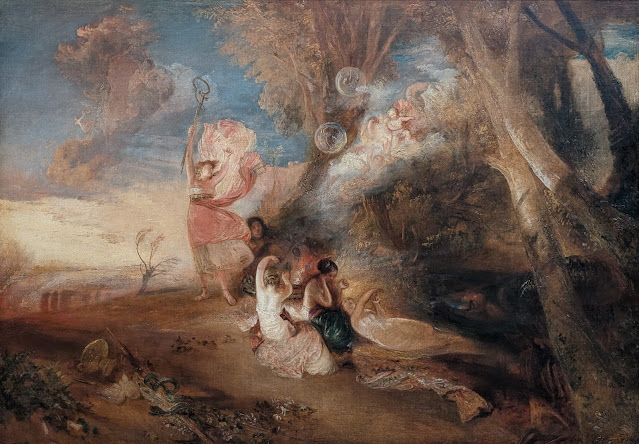
This painting was originally ridiculed. 

Medea is an epic character from Greek mythology. Having been rejected by the miscreant Jason, leader of the Argonauts; she decides to murder her own prepubescent children to spite her cheating husband. This has to be one of the most cruel and wicked action in a mythological tale. The enchantress sets free a snake (behind the tree in the darkness) on the children.

The painting was criticized as being too difficult to make out; and I have to agree. 

I don’t think this captures the evil of Medea.

✲✲✲

View of Orvieto, Painted in Rome by J.M.W. Turner (1828)

This is quite pleasing, but not as captivating as the others. I feel like there’s something missing here. Perhaps too much enveloping darkness. It gives the painting a shade of gloom and obscurity which has the effect of concealing. The two women are bathed in radiant sunlight, perhaps from the opening in the trees. Washing clothes.

Painted in Rome 1828. Turner passed through Orvieto on his way to Rome.

(A suggestively clad voluptuous lady in the sunshine?)