Back in January, I went to a small exhibition at the National Gallery celebrating John Constable’s iconic The Hay Wain.
Constable and The Hay Wain was a wonderful exploration of this beloved painting, its influences and its legacy. The shortcoming in the exhibition, I felt, was gallery’s maladroit handling of Constable’s non-political art against the purported exegenices of activism in his day. But, this can probably be written-off as a bit of the usual wokeism.
Overall score: ★★★★ 4/5
✲✲✲
The Hay Wain by John Constable (1821)


According to the gallery, it sat in a french collection until 1886. It seems that when Constable first exhibited the painting in England, at the Royal Academy of Arts, in 1821, it did not sell.
The painting was received to great acclaim in the 1824 Paris Salon though, with a gold medal from the king of France, Charles X.
✲✲✲
Part 1 - The Hay Wain as a national icon
 |
| 1910-20 photo of the house featured in The Hay Wain. |
Originally, the house in the painting was the property of a tenant farmer called William Lott. He lived there during Constable’s lifetime. Apparently, he rarely ventured outside his home.
But, by 1925 it had fallen into disrepair. A local MP (Thomas Parkington) then bought the estate and restored the building (as Constable depicted it).
The serene & “prelapsarian” calmness of The Hay Wain has made this picture an enduring cushion to the hurly-burly of modernity. An antidote. A refuge to happier times.
Yet, despite this, I still found myself surprised at just how easily this panorama has become the object of those who wish to agitate and shock us from our supposed apathy, such as:


The Hay Wain has been used by Peter Kennard for the Campaign for Nuclear Disarmament (Haywain with Cruise Missiles). In 2022, Quentin Devine recreated this image to warn about the dangers of the climate change.
✲✲✲
Part 2 - Contextualising landscape painting in Britain
Next the exhibition turns to the subject of land as an “issue of politics”. I.e. - who owned land, the right of common access, restrictions on foreign grain imports (“Corn Laws”) following the Napoleonic Wars resulted in food prices rocketing.
Ms Christine Riding, curator of the exhibition, takes the view that landscape is political. As such, pictures of agriculture and harvest take on a “new significance” in the context of the era. Some artists wanted to create a picturesque image (inspired by the Dutch & Flemish) and some sought to closely reflect the natural world.
For me, I am not sure I accept the premise that the landscape is necessarily political. It may be; or it may not be. I think it is a bit harsh to judge Constable against these standards. Constable represented a departure from previous landscape paintings. They were very classical and stylised methods which did not necessarily reflect life. Constable only worked from life and made very intense and detailed sketches. His inclusion of peasants and farmers was also revolutionary. His work (alongside JMW Turner) inspired the future French Impressionists and he was highly regarded in France.
Why should Constable have expressly included the social ills suffered by lower classes in Britain? He wasn’t trying to be the rural equivalent of Hogarth. He wanted to paint something beautiful, that he loved.
✲
Marlingford Grove by John Crome (1815)

John Chrome was used by the National Gallery to illustrate the clear influence of Dutch and Flemish landscape art (light and shade in everyday woodlands) in England’s Norfolk County.
✲
The Coming Storm, Isle of Wight by George Morland (1789)

Another instance of the gallery showing how the Dutch landscape motif had become a regular among British artists (incl. cottage).
Apparently, George Morland was a particularly popular artist in the earliest years of Constable’s training in London.
✲
The Reapers by George Stubbs (1783)
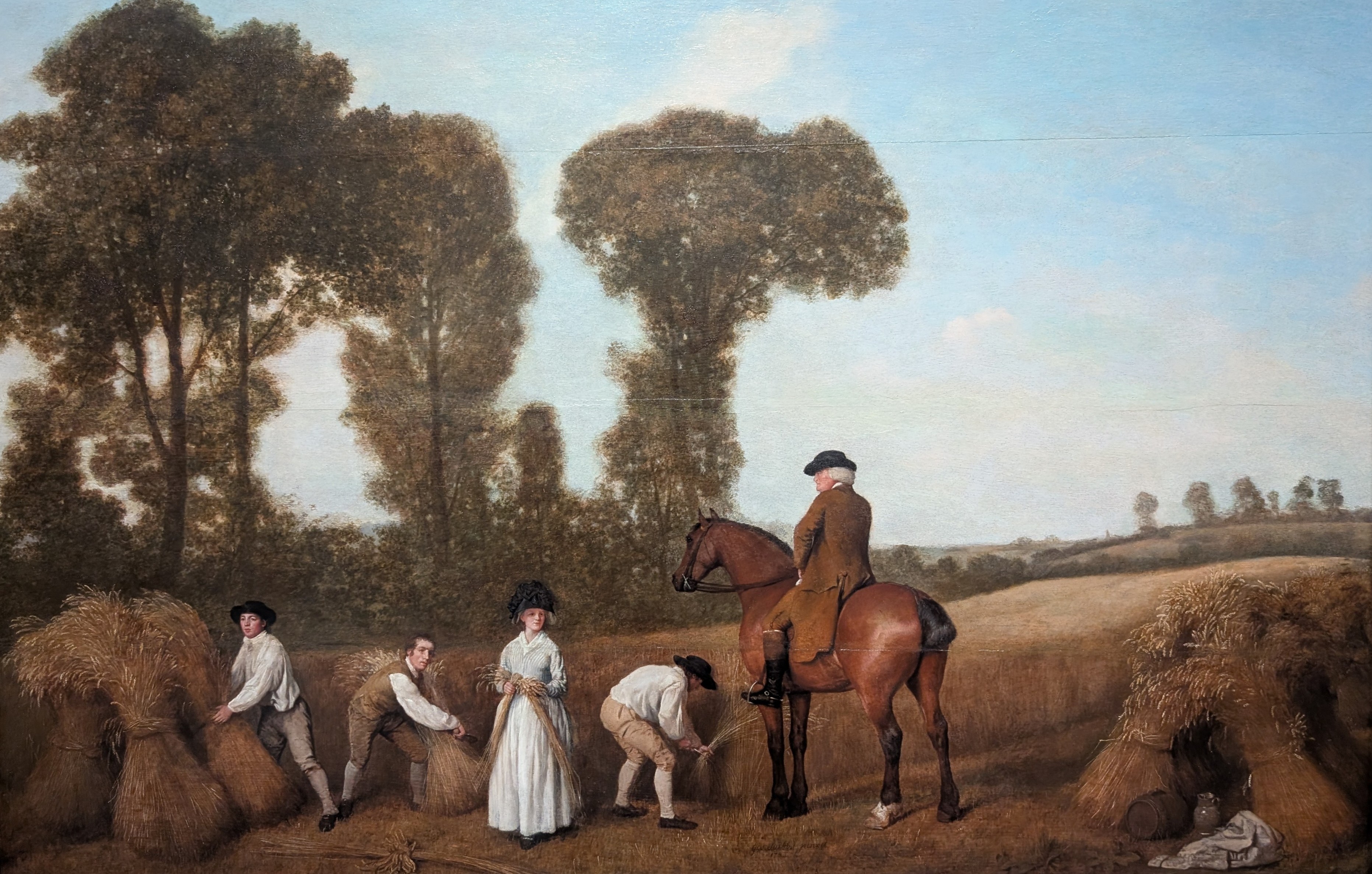
Stubbs is already acclaimed for his paintings of horses.
This painting’s social commentary is quite clear. The relationship between the reapers, who cut and gather the crops, and a gentleman farmer. This while still a picturesque rural subjects (in the Dutch style).
✲✲✲
Part 3 - Making of the Hay Wain
The exhibition shows how Constable built his finished works from sketches, studies and memories of locations he knew and loved.
The Hay Wan depicts the River Stour and the land alongside Batford Mill (which Constable’s father owned). In order to create it, Constable referred to a series of drawings and sketches he had produced over many years beforehand. He made the final painting in his London studio based on these sketches and his own familiarity.


The National Gallery notes:
At the time Constable made the later study, villagers in nearby East Bergholt were protesting the fencing-off of common land for private use. There is no sense of unrest in this peaceful scene.
As I said earlier, why should Constable paint “unrest” in the painting, when that wasn’t the object sought.
Unfortunately, and especially since the rise of identity politics, highbrow exhibitions, like this one, are expected to condemn antecedents for the insufficient activism and moral impurity to a modern audience.
✲
The Mill Stream by John Constable (1814-15)

Another picture of Constable’s enduring love with his childhood landscape.
The National Gallery have included this beautiful painting of the Mill Pond - but from a position further along the bank. He included similar characters and details to the Hay Wain.
Wonderful.
✲✲✲
Part 4 - After the Hay Wain
I have been to a small exhibition, at the Tate, which explored Constable’s lifelong investigations of the movement of clouds and the effects of light. It’s very interesting, to me, how his painting techniques, in his later works, became “looser” and more expressive (impressionistic).
✲
Salisbury Cathedral from the Bishop’s Ground by John Constable (1823)

A magnificent painting.
The Bishop of Salisbury (and Constable’s friend) commissioned this painting in 1820.


According to the exhibition:
In his lifetime the artist’s work received mixed responses in Britain. Some viewed his paintings as equal to revered earlier artists, while others felt his approach was unsuccessfully experimental. Following his death, prominent figures such as the art critic and social commentator John Ruskin condemned his style as ‘blundering’ and ‘superficial’. His critical popularity in Britain initially declined as a result. But this changed as his influence on the work of lauded French artists, including Eugène Delacroix and Claude Monet, began to be acknowledged.
Over time Constable came to be viewed as a key figure in British art history. His admirers, collectors and family members helped secure his reputation by ensuring his work entered the collections of major galleries and museums in the UK and beyond.


.jpg)


