Showing posts with label Edgar Degas. Show all posts

Wednesday, August 7, 2024

“Discover Degas & Miss La La” exhibition at the National Gallery

I went to a wonderful exhibition recently on Degas’s painting of “Miss La La at the Cirque Fernando”.

The National Gallery is currently celebrating its bicentennial birthday. And this exhibition is a lovely touch. It combines drama and spectacle with art and race. What makes this show so refreshing is that it is free of our present day identity-politics and ideological framing.

I had already covered this painting some years back on a visit; so it was a pleasure to see it again.

It was based on newly discovered information about the painting and its sitter.

✲✲✲

Part 1

Miss La La at the Cirque Fernando by Edgar Degas (1879)

A stunning painting.

Miss La La (the acrobat) is ascended towards the rafters of “Cirque Fernando” via a rope clenched between her teeth. Captivating, and slightly horrifying. 😳

The architecture intensifies the dramatics. Her real name is Anna Albertine Olga Brown. Born in 1858 in Prussia (Poland) to a white mother and African American father. She died in 1945. In her time, she reached international fame.

In 1879, aged 21, Degas had attended one her performances at the Cirque Fernando in Paris. He found her mesmerising & painted her suspended gracefully at her most perilous moment.

Her sketched her many times, and invited her to pose in his studio.

This painting was then dispatched to 4th Impressionist exhibition in Paris in 1879.

✲✲✲

Part 2 - Photographs of Olga

Olga Brown, aged 20-21.

Olga with dignity and beauty.

Olga with Manuel Woodson (from America) and Rose Eddie.
At this point, she ran a cafe and inn for stage artists.

Olga Brown Woodson in Brussels, aged 80-82.

✲✲✲

Part 3 - The Cirque Fernando (Degas & Renoir)

Miss La La was the highlight of the show and she became a sensation.

In 1879, Renoir also painted a scene set at Cirque Fernando, showing other acrobats. He was also a keen circus-goer.

Acrobats at the Cirque Fernando by Renoir (1879)

A more static pose by Renoir.

This painting shows 2 acrobat sisters Francisca (on left) and Angelina Wartenberg.

They are wearing costumes identical to Miss La La’s. They have concluded their performance & are gathering oranges tossed over by the audience.

They are pretty, pale, glittery with an aura child-like sweetness. A total opposite of Degas’s strong and fearless gymnast prodigy.

Beautiful golden daubs over fine brushstrokes.

✲✲✲

Some of Degas’s notes and sketches:


✲✲✲

Part 4 - Degas and the “Black World”

Degas painted Olga with her natural hair and dark skin colour.

The exhibition explains that Degas was born of a Creole mother (of European descent) from New Orleans. And it suggested that this may have had an effect.

For me, it doesn’t seem obvious either way. He visited New Orleans in 1872 and it seems he was impressed by the sight of the sizeable black population. He was also fascinated by the juxtaposition of dark and light, and described Black people walking in the bright sunlight like “silhouettes”.

✲✲✲

Courtyard of a House (New Orleans sketch) by Edgar Degas

This scene was from Degas’s family home in New Orleans.

His family employed a black nanny who is on the left and is looking after Degas’s nephews and nieces. He paints her crunched low, cropped, and with a rather large hat on her head covering her.

It is clear this little girl (turning to look at us) was special. I love the addition of the family dog (also gazing at us).

✲✲✲

Lady in Black by Edgar Degas

In this painting, Degas experiments with the effect of light pouring through the white linen curtain.

He called it the “contre-jour” (i.e. against day) which creates a silhouetting effect. It gives the sitter a dark shape in which her identity disappears.

For me, I don’t think this was the effect he was striking in his “Miss La La” painting at all.

✲✲✲

Part 5 - The painting’s afterlife

A rather sad note about the painting:

Once complete, Degas sent his painting of Miss La La to the Fourth Impressionist exhibition in Paris. It was one of his most ambitious works ever shown at any of these independent shows he had helped organise. Yet the painting attracted little attention and did not sell. Degas kept it in his studio for almost 25 years, before it was sent to exhibitions outside France, including a major show of Impressionist paintings in London in 1905. Bought by a Canadian billionaire, the picture spent the next twenty years or so in Toronto, before being purchased for the National Gallery in 1925, with the Courtauld Fund.

By then Degas had died and Olga, long retired in Brussels, likely never saw the painting at the National Gallery. Miss La La inspired in British painters of the period several circus-themed artworks: celebrations of agility, movement and colour, imbued with the same atmosphere of excitement as Degas’s painting.

✲✲✲

The Daredevils by Thérèse Lessore (1927-1934)

The exhibition shows us Lessore’s portrayal of

the World’s Fair in Islington, London. The curved arches of the building & green columns are all nods to Degas’s composition.

Lessore married Walter Sickert (below) as her second husband in 1926.

✲✲✲

The Trapeze by Walter Sickert (1920)

A friend of Degas’s.

Sickert saw the painting of Miss La La hanging in his Paris apartment in 1885.

According to the gallery:

The Trapeze owes a clear debt to the Impressionist master’s picture, with its daring upwards perspective: a swaying figure on a swing stretches her arms to reach a trapeze, her body aligned with the radiating seams of the circus tent above her.

Thursday, October 19, 2023

More Impressionism and Post-Impressionism at the National Gallery

This post is about some of the changes, rotations, loans and new acquisitions to rooms 43 and 44 at the National Gallery.

✲✲✲

The Petit Bras of the Seine by Claude Monet

Lovely.

I think there is something quite special and striking about poplars against a solemn landscape and calm riverbank.

This is not the first time Monet has captured Poplars.

I really love the way the river gently curves towards the empty horizon.

✲✲✲

Eva Gonzales by Edouard Manet

This the painter Eva Gonzales. She was Manet’s model and then his student.

She has those lovely rich curls, her marble complexion, engaging features; but that elegant satin gossamery dress is just so beautiful. I’m always amazed at how artists - like Manet - can make the folds of a dress look so delicate, like the feathers of a dove.

I also noticed those flowers on the floor. It’s probably form the vase she’s observing in the painting.

Gentle white brushstrokes, feather-like texture.
Painting within a painting.

✲✲✲

Portrait of Elena Carafa by Edgar Degas

I like the pose, and the direct gaze.

Elena Carafa was Degas’ cousin from Italy.

I do like the inclined angle towards the viewer, her nose is rather cute, and those keen and perceptive eyes. Her general face is a bit inscrutable though. It’s as though we’ve interrupted her reading.

It’s also nice the way her shawl melts into her black dress.

✲✲✲

Portrait of Carolus-Duran by Edouard Manet

This is Manet’s fellow artist Carolus-Duran. He reminds me of TinTin, which makes me smile.

Cap-off, hand-on-waist, riding boots, the confident swagger, slight hint of a contented smile, thick wavy hair ... it has the feel of those great stately portraiture.

I think this painting is unfinished.

✲✲✲

Ballet Dancers by Degas

Degas’ ballet dancers is just so beautiful.

If someone described a Degas painting to you, you’d picture some treacly cliche over a kitchen’s table in a typical lovely Auntie’s house. Instead, in Degas, there is an expressive force and weight to the figures matched by the grace and fluency of their interactions .

The vibrancy of his colours is also very striking and distinctive. It has, I think, a darker palette.

I love the way we can feel the texture of the canvas beneath ... that coarseness.

✲✲✲

Lake Keitele by Akseli Gallen-Kallela - 1905

This is quite interesting.

Akseli Gallen-Kallela was a Finnish artist, and here he painted Lake Keitele.

There is something mystical and ethereal about this painting. Those ridiculously long shadows of the island in the water, the untrammelled waters, the silvery streaks crisscrossing and dissecting the painting.

It’s also hard to tell what those white forms are across the water, perhaps some clouds but they doesn’t seem correspond. Perhaps something symbolic?

✲✲✲

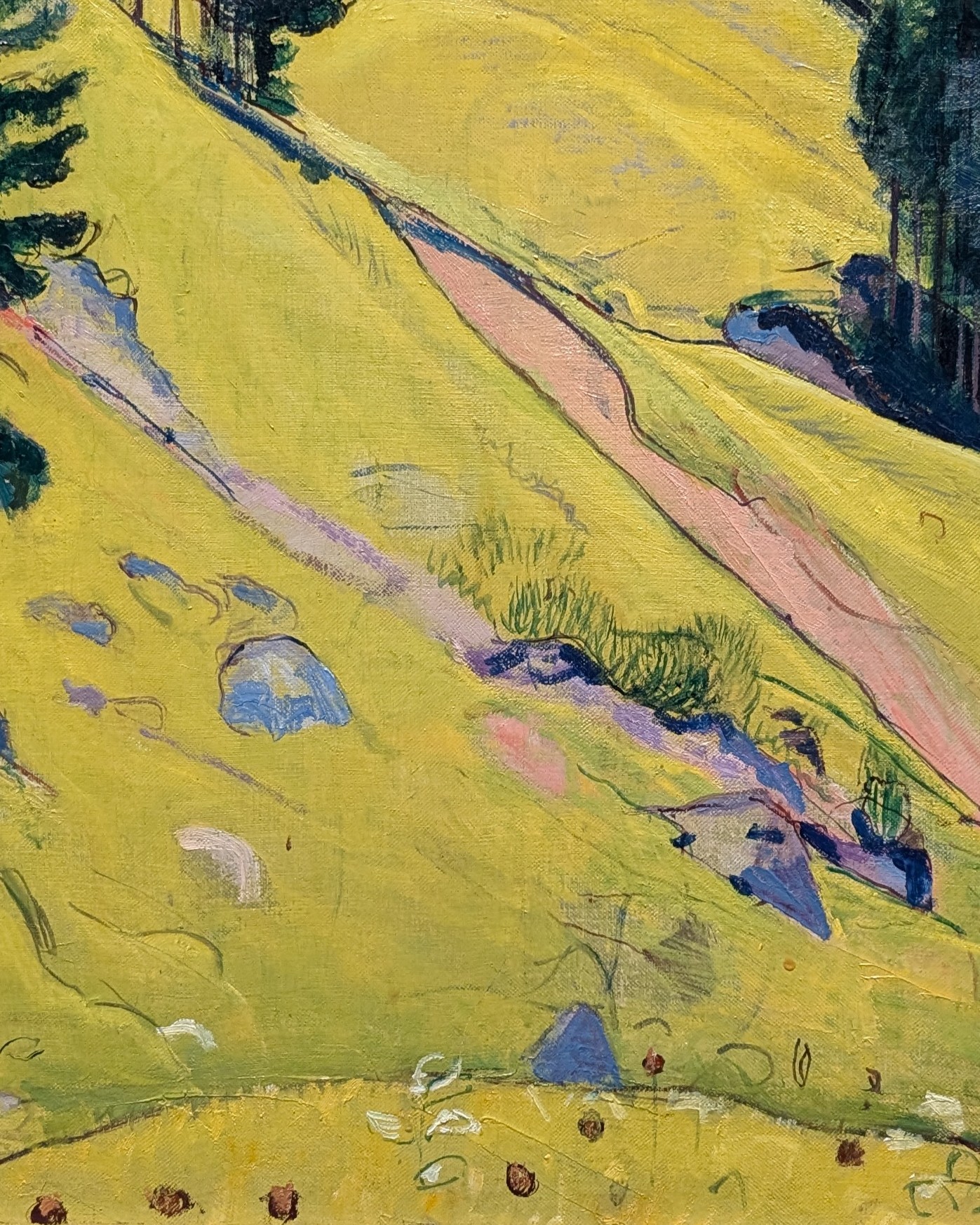
The Kien Valley with the Bluemlisalp massif by Ferdinand Hodler

Love it.

Reminds me of Gauguin and we can see the Japanese wood-prints influence. But I’m not sure what I think of this.

Its clear Hodler’s imbuing the landscape with emotion and a striking colour (which is v. effective). The Alps are rendered a commanding and meditative force. Quite beautiful.

Life is made cartoon-like and ornamental in the sea of yellow.

✲✲✲

In the Bibemus Quarry by Cezanne

So beautiful.

This is supposed to be a quarry but Cezanne almost gives us the inside of a flower. The quarry walls being petals opening up.

I love the way the brown-orangey-rust colours melt as rock layers in an escarpment.

Human figure, with his hat on, and coat on shoulder ... striding forth.

✲✲✲

Woman in the Garden by Henri de Toulouse-Lautrec

I like it.

It reminds me of Toulouse-Lautrec’s painting of Tristan Bernard.

Nice brushwork that creates texture for the lady’s clothes and the green foliage.

I also like the nose and lips on the young woman’s profile.

✲✲✲

La Terrasse at Vasouy, The Lunch, Part 1 by Edouard Vuillard

Vuillard gives us a wonderful summer fete.

This is supposed to be his friends eating outside with Paris literary and artistic circles.

Vuillard’s colours are incredible - so raw and yet so harmonious.


It doesn’t feel like this was painted on a canvass ... more like a slab of concrete!

We can really appreciate his wonderful impasto.

✲✲✲

La Terrasse at Vasouy, The Lunch, Part 2 by Edouard Vuillard

Just beautiful.

This painting was originally part of a single decorative panel (with the above painting).

Two little sweethearts being tended by a nurse in such a summery garden. I love the nurse’s hat; and those clouds have an amazing billowing texture and hue.


Some more impasto shots.

✲✲✲

Still Life with Water Jug by Cezanne

Another classic Cezanne - but unfinished.

Depicting a blue water jug and a plate with apples. The way the apples meld into and with the surfaces!

✲✲✲

Avenue at Chantilly by Cezanne

I really do like these type of Cezanne paintings. It doesn’t feel like these is much on the canvass; but a lot is carried here.

Interesting use of space and perspective. Looks like two openings. One to the clouds and the other to the red sphere (a sun?). I like interplay of the greeny foliage against the shadowy floor and the orange sandy middle.

It’s very beautiful.

Cezanne spent a few months in the north of France, around Chantilly.

✲✲✲

Harvest: Le Pouldu by Paul Gauguin

Interesting.

The thing about Gauguin is that the landscape and characters obey a simplified geometry and form; against which is defined blocks of basic colours. For instance, the sea (in the background) doesn’t really seem to obey the conventions of linear perspective. It feels a bit strange, curtain-like.

I often feel that there is an undertone of darkness in Gauguin’s paintings. Some kind of struggle which he seeks to capture. For instance, I didn’t really warm to ‘The Wave’ and ‘Nevermore’ (which I discussed at the ‘After Impressionism’ exhibition at the National Gallery). Though they are masterful.

For me, there is a subdued warmth in the colours - especially in the harvest - which accentuates this peasant community’s toil.

That poor lady’s bearing.

✲✲✲

Fruit Dish, Bottle and Violin by Picasso (1914)

A nice analytic drawing that cuts across structure and viewpoint.

I like Picasso’s encouragement, to us, to look at life through his unique lenses; but but I sometimes struggle to understand what Picasso is trying to teach us here about his perspective on life. Picasso didn’t see his furniture, bowls of fruit, bottle, violin in collapsed or cubist sharp lines and edges.

For me, when I see this kind of painting, I think its a clever illusion. Picasso is a visionary master of technical skill, but it’s hit-and-miss with me and Picasso. Sometimes I really like his paintings; but other time I struggle to see him communicate something profound.

But hey-ho. We’re all different.