Showing posts with label Victoria and Albert Museum. Show all posts

Thursday, July 23, 2026

The Feminine Gaze and Botticelli’s Smeralda

Portrait of a Lady known as Smeralda Bandinelli by Botticelli (1470-1480)

This portrait (at the Victoria and Albert Museum in London) always makes me smile.

I think she has a real warmth and presence that jumps right across 550 years.

For its time, this was a radical painting: it’s one of the most early Florentine portrait depictions of a secular woman in a three-quarter pose. If you look at the early renaissance, this kind of painting really marks a shift. For example, Verrocchio, who later trained Botticelli, easily conformed to religious paintings (of the time) in which the Virgin Mary is rendered in three-quarter - e.g. The Virgin and Child with Two Angels at the National Gallery, London. But not an ordinary woman.

Botticelli rendered a level of psychological presence going beyond (even exceeding) those reserved for the Virgin Mary.

I think the pinnacle of this artistic psychological depth and artistic power (with respect to the feminine gaze) was wielded by Leonardo da Vinci:

Portrait of Ginevra de Benci by Leonardo da Vinci

A funny twist to this legend, and which directly ties the Italian renaissance to Victorian London is that Dante Gabriel Rossetti spotted this painting at Christie’s and bought it. It’s connection to the Pre-Raphaelites is quite obvious, I think.

The Lady of Pity by Dante Gabriel Rossetti

✲✲✲

At any rate, I was curious to know who this lady was that Botticelli painted.

Thanks to deligent art historians at the V&A it is possible that a grandson or descendant from the Bandinelli family (in the 1600s) added that name to the bottom of the painting way after it was painted. In those days, families would sometimes “forge” inscriptions to older beautiful artworks to claim that their ancestors were noble and important enough to be painted by masters, like Botticelli.

This leaves us with the fascinating reality that she remains a mysterious beautiful lady from 1470s Florence. 

Her very anonymity draws us to searched out the actual person Botticelli captured on the wood panel.

Tuesday, June 30, 2026

The Holy Roman Emperor Charles V

I saw this commemorative medal dedicated to Emperor Charles V. 

He is on my list of top 10 historical figures I wish I could talk to.

Beautiful German Renaissance craftsmanship: “silver-gilt medal was made by Hans Reinhardt the Elder, in Germany in 1537.

✲✲✲

I’ve been deeply fascinated by Charles V. 

His power was unrivalled in the 16th century and he completely changed European history, but I also think an overall decent(ish) Emperor.

  • The Sack of Rome - Charles V’s own army caused the Sack of Rome. The army hadn’t been paid in months, and they were practically starving. The Duke of Bourbon (defecting from King Francis I of France) was nominally the “commander”, but had very little control over them. He gave an order to “take Rome”. His Imperial troops attacked and the army turned into a leaderless mob. The Sack of Rome was a total collapse in all human decency and human restraint. Torture, mass murders, and mass rapes (even of nuns). The great basilica of St Peters was used as a stable for horses. It’s probably unknown how many irreplaceable manuscripts and masterpieces were destroyed. He was publically horrified by his own army and it is a great irony: the man who spent his life fighting to preserve the Catholic Church against the Reformation was the same man whose army effectively destroyed the Renaissance Papacy. Renaissance too. 
  • The Dutch Golden Age - Flemish Charles V was the unintentional “founding father” of the Dutch Golden Age. His religious policies and his eventual abdication, and giving the Netherland to Spanish Philip II, set the stage for the Netherlands to become a global superpower.
  • Causing Henry VIII to leave the Catholic Church - Normally, Popes granted favors to kings all the time. But Charles V forced the Pope’s hand preventing the annulment. The irony here is that Charles inadvertently helped create one of the most powerful Protestant nations in European history which then became a massive rival to his own deeply Catholic son, Philip II. One of the first major Catholic but secular forces that reigned Papal power.
  • Humble End - He died as a simple monk (mostly), wearing plain clothes instead of robes.

Tuesday, March 24, 2026

The Eltenburg Reliquary

Wow. Saw this stunning object at the V&A in London. 

The Eltenberg Reliquary is a magnificent 12th-century masterpiece of Rhenish Romanesque art - 1180 AD.

Probably used to house sacred relics, e.g. the Eucharist.

Has that Byzantine dome, gilded bronze, exquisitely carved ivory ...

It shows how redundant our views of the Middle Ages as the ‘Dark Ages’, as little more than mud and superstition.

Elephant ivory used to depict the Crucifixion.

Monday, October 20, 2025

Angel with Candlestick by Luca della Robbia

I saw this piece in the V&A.

Della Robbia’s angel is a plaster cast of a Renaissance sculpture in Florence’s Cathedral (now: Duomo’s museum).

The angels would have held the sanctified bread used during the Mass.

According to the V&A, “the plaster copies displayed here do not reproduce the colour of the originals”. That is because Della Robbia was known for inventing his “tin-glazed terracotta” sculpture technique. This glazing created a lustrous & water-resistant surface which exists to the present. Thus, they retain their white, deep cerulean blues and gilding against the deteriorating of the weather.

For art history, Luca Della Robbia holds an important role. He was pivotal in the early Italian Renaissance influencing the latter generation, including Michelangelo. Wikipedia says:

Della Robbia was praised by his compatriot Leon Battista Alberti for genius comparable to that of the sculptors Donatello and Lorenzo Ghiberti, the architect Filippo Brunelleschi, and the painter Masaccio. By ranking him with contemporary artists of this stature, Alberti noted the interest and strength of Luca’s work in marble and bronze, as well as in the terra-cottas always associated with his name.

Saturday, August 23, 2025

Lorenzo Ghiberti

Lorenzo Ghiberti and Filippo Brunelleschi are the two most important sparks of the Florentine Renaissance.

Ghiberti was the bridge between the Gothic and the Renaissance. His sculptural technique involved a new level of intricacy and detailed with a level of realism and emotional depth that had not been seen before.

I hope you'll agree they are quite moving. I can only imagine how powerful they were in the 15th century. It also explains why they became so popular. 

Below are two beautiful sculptures that I want to share from 2 different museums. 😁

✲✲✲✲✲

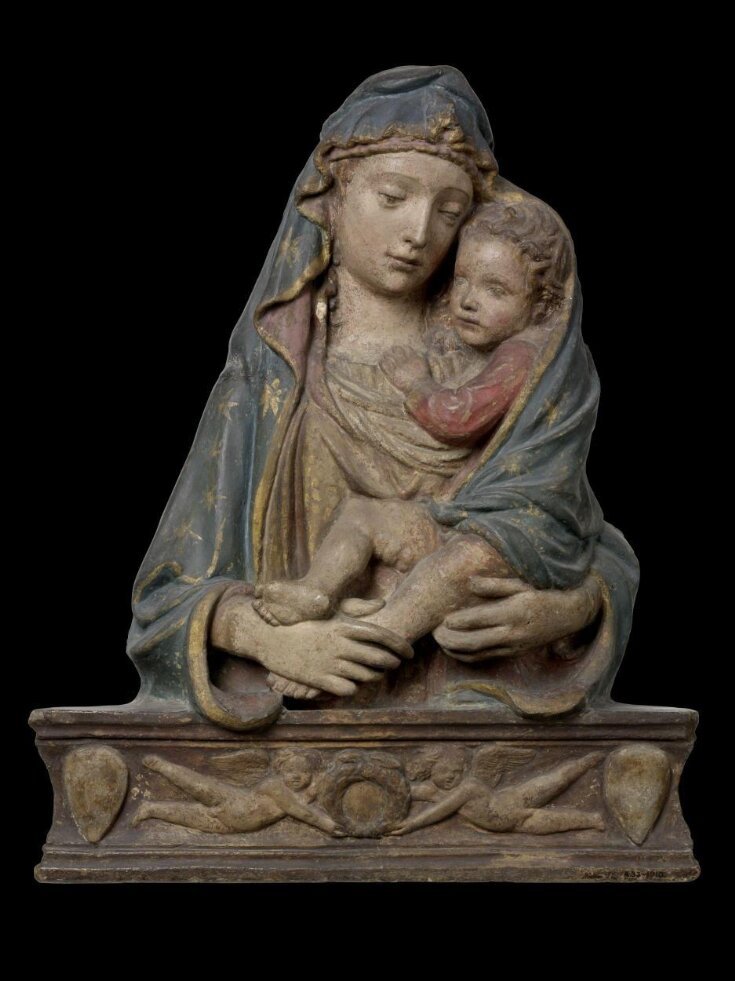
Madonna and Child by the Circle of Lorenzo Ghiberti

A beautiful sculpture & important to art history.

E.g. from V&A London.
This relief is from the Ashmolean at Oxford. 

It depicts the Madonna and Child.

It’s one of a number of 30-40 surviving variants based on the characteristics of the Florentine bronze sculptor Lorenzo Ghiberti. 

He is one of the forefathers of the Italian renaissance - renowned for his bronze doors for the Florence Baptistery. 

The mother’s serene face, the adoring arrangement of mother-and-son, and the baby Christ’s pose (by her shoulder) are characteristic of Ghiberti’s style. See e.g.

✲✲✲✲✲

Seated Virgin and Child by the Circle of Lorenzo Ghiberti and Donatello (~ 1415)

A loving & graceful embrace, and yet with a pensive sadness.

The mother seems slightly lost in her melancholy, as her son wraps his arms around her. Her fingers seem to reach around to lift him closer to her. 😔

This terracotta from the Victoria and Albert Museum in London.

No wonder Ghiberti was so influential.

According to the museum, it is close to the style of Ghiberti’s workshop, where the young Donatello worked in.

Tuesday, September 3, 2024

The Great Wave off Kanagawa by Katsushika Hokusai (1831)

Just so captivating.

I went to the V&A museum especially to see this woodblock print (rest can be seen in my fuller review). 

It is an alluring and beautiful painting - and the wave is thrilling and fearsome.

The fishermen are rowing *into* the waves, not escaping it.

It is really gorgeous. And no wonder it is one of the most enduring and striking works of Japanese art in the world. The Great Wave off Kanagawa was published around 1830 as the first in the series “36 Views of Mount Fuji”. 

I think it speaks to our ability to overcome obstacles — even those beyond our control. It is an interpretation of resilience.

✲✲✲

I recently watched a BBC documentary on this painting.

The Great Wave of Kanagawa was published after the period of time during which Japan was closed off to trade, which made their art more appealing and exotic to Europeans. It was also published during the Enlightenment, when Western European countries were pursuing discovery for the sake of furthering knowledge. 

What is fascinating is that Hokusai became inspired by Dutch paintings and art that arrived in Japan (notwithstanding its isolation). He imbued “European techniques” into the traditional Japanese woodblock prints. Then, later, the Impressionists gets inspiration from Japanese and Hokusai’s prints ... and then imbue “Japanese techniques” into the European paintings … 

The ukiyo-e style was completely new to Europeans. Elements of its composition included the use of so much negative space in the background, the lack of any clear focal point as well as perspective and the emphasis on ephemerality. In Hokusai’s wave, one gets the distinct feeling of the fugacious changing nature of life. Similarly, Monet’s Impressionist canvasses evoke the feeling of him laying down hurried brush strokes to capture a fleeting moment. There was also lack of the traditional high degree of illusionism in art. All these contributed so much to Impressionism.

Renaissance to a modern Impressionist style.

Hokusai’s wave is like a conversation across time in which people share their life views.

“Japan: Myths to Manga” exhibition at the V&A

I recently went to the V&A exhibition onJapanese Ukiyo-e art. I thoroughly enjoyed it.

The term Ukiyo-e (I think pronounced: you-kay-ohh-way (?) ) refers to the “floating world pictures” that emerged in Japan (esp. among the merchant class) in 17th century and flourished in the 18th to 19th-century.

For a long time, Japan was closed off from the world. They relied on traditional and strict social order.Samurai at the top ... followed by artisans and farmers ... and then the lowly merchant class at the bottom of the social order. Social mobility between the class was prohibited. And since tax rates were arbitrarily fixed in a period of relative peace, the merchant class benefited most from the city’s rapid economic growth.

This class developed theYoshiwara (pleasure quarters) and they relished pictures of geishas, courtesans, and the kabuki theatre — especially featuring female beauty. However, by the 19th century, artists such as Hokusai, made landscape images popular too.

Ukiyo-eis originally a Buddhist term referring to the transitory and ephemeral nature of life. It was applied to the “Yoshiwara district” (red light) of ​​the city of Edo (modern-Tokyo) during the Edo period (1603-1868). It housed brothels, theatres and tea houses.Edo became the seat of government for the military dictatorship in the early 17th century.

✲✲✲

Sunrise at Susaki on New Year’s Day by Utagawa Hiroshige

Utagawa Hiroshige was one of the famous masters of the Ukiyo-e woodblock printing tradition.

He created thousands of prints of everyday life and landscape in Edo period Japan with colourful & saturated ambience.

Here, it is clear that blazing sun is deeply connected to Japanese culture. The country’s name in Japanese, “Nihon”, means “origin of the sun”. Moreover, it is considered good luck to see the first sunrise of the year, aka “Hatsuhinode”.

Hiroshige wanted the rising sun to saturate the background of the buildings ... but he also wanted to bring us closer to the 2 ladies on the bridge.

According to the V&A:

This is the first of a set of three designs unusual for the way in which the distance between viewer and subject progressively decreases, so that the focus of attention shifts from the overall view of this design to a stylishly clad woman in the third.

✲✲✲

Star Festival at Yanagishima by Utagawa Hiroshige

The woman designed by Hiroshige is sitting in a roofed pleasure boat.

The bridge is the “Yanagishima Bridge” (which looks like still stands today?). This is supposed to depict a religious festival (the “Tanabata Festival”) in which stars prefigure the culture in terms of stories and guidance.

As before, I noticed women’s’ line of sight towards our right-hand space. Very stylish too, and the spatial depth engaging (if not at all in line withBrunelleschi).

✲✲✲

The Seventh Month (from the series “The Five Festivals”) by Utagawa Kunisada

Magical. Utterly beautiful.

The dresses colouring is astonishingly vibrant and fantastical. Mixed with the dancers motions, it creates abreathtaking dynamism.

These transfixing women are gliding and dancing to celebrate the “Tanabata festival” (see above) on the seventh day of the seventh month.

According to legend, when the stars Vega and Altair are aligned, two lovers are reunited. He herds cows, and she weaves fine silk.

The surface of a lake over which fly? The wind is clearly blowing through.

✲✲✲

The Origins of Sacred Dance at the Heavenly Rock Cave by Utagawa Kunisada

“Amaterasu no Ōkami” is the goddess of the sun who brings light to the world.

When her brother misbehaves, Amaterasu is frightened and hides in a cave. But, when she seals herself in, darkness falls on everything.

In this painting, gods and goddesses gather at the cave. They sing, dance and drum ... to tempt Amaterasu out of the cave.

What is interesting is the luminous lines of gold which transect the painting & remind me of Gauguin’s use of colours. The ground is abstracted and we have drapery behind the woodblock’s sun rays.

It’s also interesting how the aesthetic transformation of depth in a distinctly three-dimensional scene turns it into a playful, dynamic two-dimensional plane.

✲✲✲

The Former Emperor from Sanuki Sends Allies to Rescue Tametomo by Utagawa Kuniyoshi

Wow!

What a chilling fish (those scales, teeth and eyes!) and the incredible blue waves and ghost-like goblins saving the epic Samurai warriors.

Under Japan’s waves, the seas are packed with life. Japan’s folklore is about encounters with their sea creatures.

The gigantic terrifying fish has mouth wide open with razor teeth. The goblins straddle the fish and rescue warriors.

✲✲✲

Urashima Taro and the Dragon Palace in the Sea by Ogata Gekko

This is the tale of “Urashima Taro”:

One day, a fisherman called Urashima Taro saves a turtle. In thanks, the turtle takes him to the underwater palace of the dragon king. There she magically transforms into a princess. She gives Urashima Taro a beautiful box but tells him never to open it. Homesick, he returns to dry land, only to discover that many years have passed. Despite the princess’s warning, Urashima Taro opens the box. The missing years catch up with him and in an instant, he becomes an old man!

The city life blends into clouds as Taro flies.

✲✲✲

Treasure Ship by Utagawa Hiroshige

Colours are so vibrant. Beautiful crests on the waves ...

At the New Year, many Japanese used to place pictures of the Seven Gods of Fortune on a treasure ship under their pillows for a happy year ahead.

In Japanese mythology,there are Seven Gods of Good Fortune. They ride together in a glittering treasure ship & each god brings good luck to people in different jobs. Fishermen, farmers, dancers etc..

✲✲✲

The Whirlpools in Awa Province (from the series Famous Places in the Provinces) by Utagawa Hiroshige
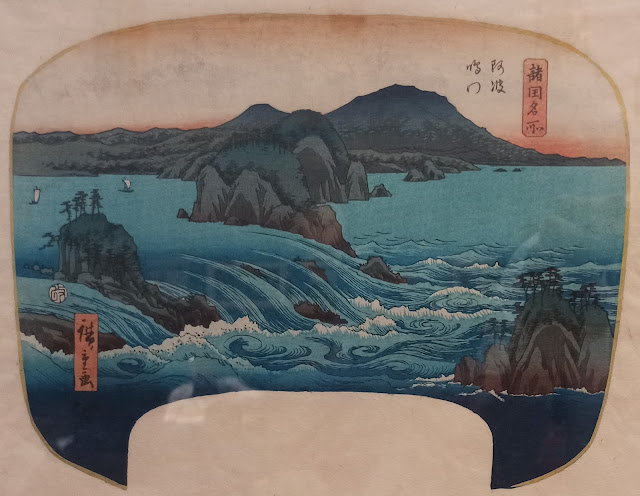
Waves are v. beautiful. Love the crepuscular sunshine on the horizon.

✲✲✲

Woman and Children by the Sea by Utagawa Hiroshige

✲✲✲

The Eighth Month by Ishikawa Toyomasa

✲✲✲

The Great Wave off Kanagawa by Katsushika Hokusai


Discussed in a following blog post here.