This post is about some of the changes, rotations, loans and new acquisitions to rooms 43 and 44 at the National Gallery.
✲✲✲
The Petit Bras of the Seine by Claude Monet

Lovely.
I think there is something quite special and striking about poplars against a solemn landscape and calm riverbank.
This is not the first time Monet has captured Poplars.
I really love the way the river gently curves towards the empty horizon.
✲✲✲
Eva Gonzales by Edouard Manet
This the painter Eva Gonzales. She was Manet’s model and then his student.
She has those lovely rich curls, her marble complexion, engaging features; but that elegant satin gossamery dress is just so beautiful. I’m always amazed at how artists - like Manet - can make the folds of a dress look so delicate, like the feathers of a dove.
I also noticed those flowers on the floor. It’s probably form the vase she’s observing in the painting.
Gentle white brushstrokes, feather-like texture.
Painting within a painting.
✲✲✲
Portrait of Elena Carafa by Edgar Degas

I like the pose, and the direct gaze.
Elena Carafa was Degas’ cousin from Italy.
I do like the inclined angle towards the viewer, her nose is rather cute, and those keen and perceptive eyes. Her general face is a bit inscrutable though. It’s as though we’ve interrupted her reading.
It’s also nice the way her shawl melts into her black dress.
✲✲✲
Portrait of Carolus-Duran by Edouard Manet

This is Manet’s fellow artist Carolus-Duran. He reminds me of TinTin, which makes me smile.
Cap-off, hand-on-waist, riding boots, the confident swagger, slight hint of a contented smile, thick wavy hair ... it has the feel of those great stately portraiture.
I think this painting is unfinished.
✲✲✲
Ballet Dancers by Degas

Degas’ ballet dancers is just so beautiful.
If someone described a Degas painting to you, you’d picture some treacly cliche over a kitchen’s table in a typical lovely Auntie’s house. Instead, in Degas, there is an expressive force and weight to the figures matched by the grace and fluency of their interactions .
The vibrancy of his colours is also very striking and distinctive. It has, I think, a darker palette.
I love the way we can feel the texture of the canvas beneath ... that coarseness.
✲✲✲
Lake Keitele by Akseli Gallen-Kallela - 1905

This is quite interesting.
Akseli Gallen-Kallela was a Finnish artist, and here he painted Lake Keitele.
There is something mystical and ethereal about this painting. Those ridiculously long shadows of the island in the water, the untrammelled waters, the silvery streaks crisscrossing and dissecting the painting.
It’s also hard to tell what those white forms are across the water, perhaps some clouds but they doesn’t seem correspond. Perhaps something symbolic?
✲✲✲
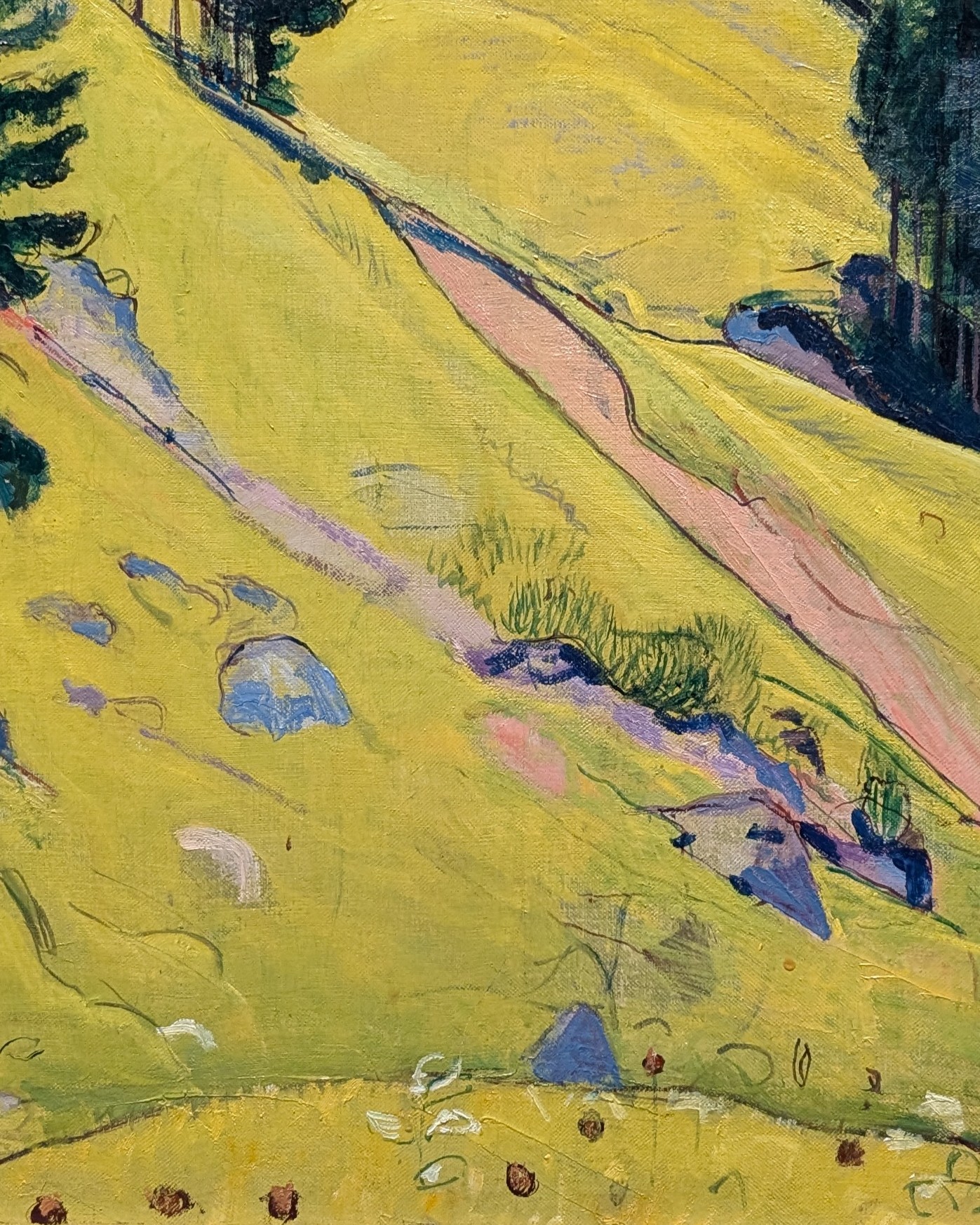
The Kien Valley with the Bluemlisalp massif by Ferdinand Hodler
Love it.
Reminds me of Gauguin and we can see the Japanese wood-prints influence. But I’m not sure what I think of this.
Its clear Hodler’s imbuing the landscape with emotion and a striking colour (which is v. effective). The Alps are rendered a commanding and meditative force. Quite beautiful.
Life is made cartoon-like and ornamental in the sea of yellow.
✲✲✲
In the Bibemus Quarry by Cezanne
So beautiful.
This is supposed to be a quarry but Cezanne almost gives us the inside of a flower. The quarry walls being petals opening up.
I love the way the brown-orangey-rust colours melt as rock layers in an escarpment.
Human figure, with his hat on, and coat on shoulder ... striding forth.
✲✲✲
Woman in the Garden by Henri de Toulouse-Lautrec
I like it.
It reminds me of Toulouse-Lautrec’s painting of Tristan Bernard.
Nice brushwork that creates texture for the lady’s clothes and the green foliage.
I also like the nose and lips on the young woman’s profile.
✲✲✲
La Terrasse at Vasouy, The Lunch, Part 1 by Edouard Vuillard

Vuillard gives us a wonderful summer fete.
This is supposed to be his friends eating outside with Paris literary and artistic circles.
Vuillard’s colours are incredible - so raw and yet so harmonious.
It doesn’t feel like this was painted on a canvass ... more like a slab of concrete!
We can really appreciate his wonderful impasto.
✲✲✲
La Terrasse at Vasouy, The Lunch, Part 2 by Edouard Vuillard

Just beautiful.
This painting was originally part of a single decorative panel (with the above painting).
Two little sweethearts being tended by a nurse in such a summery garden. I love the nurse’s hat; and those clouds have an amazing billowing texture and hue.
Some more impasto shots.
✲✲✲
Still Life with Water Jug by Cezanne

Another classic Cezanne - but unfinished.
Depicting a blue water jug and a plate with apples. The way the apples meld into and with the surfaces!
✲✲✲
Avenue at Chantilly by Cezanne

I really do like these type of Cezanne paintings. It doesn’t feel like these is much on the canvass; but a lot is carried here.
Interesting use of space and perspective. Looks like two openings. One to the clouds and the other to the red sphere (a sun?). I like interplay of the greeny foliage against the shadowy floor and the orange sandy middle.
It’s very beautiful.
Cezanne spent a few months in the north of France, around Chantilly.
✲✲✲
Harvest: Le Pouldu by Paul Gauguin

Interesting.
The thing about Gauguin is that the landscape and characters obey a simplified geometry and form; against which is defined blocks of basic colours. For instance, the sea (in the background) doesn’t really seem to obey the conventions of linear perspective. It feels a bit strange, curtain-like.
I often feel that there is an undertone of darkness in Gauguin’s paintings. Some kind of struggle which he seeks to capture. For instance, I didn’t really warm to ‘The Wave’ and ‘Nevermore’ (which I discussed at the ‘After Impressionism’ exhibition at the National Gallery). Though they are masterful.
For me, there is a subdued warmth in the colours - especially in the harvest - which accentuates this peasant community’s toil.
That poor lady’s bearing.
✲✲✲
Fruit Dish, Bottle and Violin by Picasso (1914)

A nice analytic drawing that cuts across structure and viewpoint.
I like Picasso’s encouragement, to us, to look at life through his unique lenses; but but I sometimes struggle to understand what Picasso is trying to teach us here about his perspective on life. Picasso didn’t see his furniture, bowls of fruit, bottle, violin in collapsed or cubist sharp lines and edges.
For me, when I see this kind of painting, I think its a clever illusion. Picasso is a visionary master of technical skill, but it’s hit-and-miss with me and Picasso. Sometimes I really like his paintings; but other time I struggle to see him communicate something profound.
But hey-ho. We’re all different.