Tuesday, July 8, 2025

Annibale Carracci and Caravaggio at the Basilica of Santa Maria del Popolo

Another busy day.

We had a walk around the Piazza del Popolo and went into the Basilica to see the Caravaggio paintings.

Unfortunately, I didn't realise how many other treasures were there (thanks to wikipedia) so I didn't look around too much.

Will have to return one day.

Enjoy the photos.

✲✲✲✲✲

The gate entry to the Piazza del Popolo

Piazza del Popolo means “Peoples’ Square”.
It is the “northern gate in the Aurelian Walls” (wiki).
I loved the grand and imposing facade.
The name of the square (in the distance) comes from the Church inside it, Santa Maria del Popolo.

I snapped a photo of this lady, ahead of me.
I thought it was a beautiful moment.
Her swaying & flapping dress reminded me of the Louvre’s “Winged Victory of Samothrace” in her momentary solitude.

✲✲✲✲✲

The Piazza del Popolo

An exquisite square.
It reminded me of St. Peter’s Square.

An Egyptian obelisk of Ramesses II at the centre of the Piazza.
Twin Churches in the background. Didn’t go in them. Next time.

✲✲✲✲✲

The façade of the basilica

A rather unadorned facade. Rubbish photo, I know ...

Neighbouring the Museum of Leonardo da Vinci.

✲✲✲✲✲

The nave


The Byzantine icon of The Madonna del Popolo.
Apparently painted by St. Luke himself.
Moved there by Pope Gregory IX from the Lateran.

While doing some research, I came across an interesting journal article by Shannon E. Kuziow in “Pope Sixtus IV at Santa Maria del Popolo: Marian Devotion and the Papal Agenda”. Unfortunately, it isn’t freely available. But the abstract says:

Throughout much of his career in the Catholic Church, Pope Sixtus IV was actively involved in promoting the cult of the Virgin Mary. He directly sponsored the construction or renovation of several Marian sites in Rome, including the Church of Santa Maria del Popolo, which houses a miraculous icon of the Madonna. Inside the church, Sixtus performed weekly devotions and regularly held ceremonies bolstering and celebrating the major political events of his pontificate. Through an analysis of the papal rituals that unfolded before the icon, this article demonstrates that Sixtus’s dedication to the Madonna served as a vehicle of expression for advancing the interconnected theological, devotional, and political aspects of his papal agenda. It further argues that the pope’s support of the Marian cult played a crucial role in his perceived ability to harness divine aid in the larger temporal issues plaguing the universal Church.

✲✲✲✲✲

The Crucifixion of Saint Peter by Caravaggio

This is the martyrdom of Saint Peter. He apparently requested to be crucified upside down - unworthy of dying in the manner of Christ.

Caravaggio captures the physical laboriousness of the execution. It all seems rather mundane. We only see Saint Peter and he doesn’t seem to be the visage of quiet resignation and acceptance. In fact, it’s unnerving and horrifying. It’s a dear old man getting tortured. It’s a sick painting. I also feel sorry for the executioners. It looks like a gruelling task. One can see the power of his chiaroscuro in storytelling.

I also wonder if the partially-illuminated man is a self-portrait? I especially love the shadow of the rope over the executioner’s back.

✲✲✲✲✲

The Conversion of Saint Paul by Caravaggio

An iconic painting.

I have seen this painting so many times in books, and it has always fascinated and horrified me.

Before being “Saint Peter”, he was the Roman/Jewish Saul of Tarsus. A persecutor of Christian for breaching the law of Moses. On the way to Damascus, he was (apparently) struck down by Holy light and heard the voice of Christ.

It’s a very intimate and psychological painting.

Saul is at the extremity of vulnerability — blinded by God, Christ speaking to him, with a powerful horse’s hindquarters raised and its hoof positioned to deliver a deadly kick to his exposed chest.

Caravaggio’s play on light is so effective. It looks like a single light bulb above the painting. Illuminating from the heavens and onto the singularity of Saul’s abdomen.

This painting is gripping today - I can’t imagine its effect with parishioners in Rome.

✲✲✲✲✲

The Assumption of the Virgin Mary by Annibale Carracci

Rubbish photo quality.

This is a great contrast to Caravaggio. More idealised, less chiarscuro, more balanced/dynamic painting with the viewer's eyes directed to Mary.

The Cerasi Chapel.

✲✲✲✲✲

The mosaic monument of Princess Maria Eleonora Borghese

Beautiful sky in Rome

Looked up one evening and was amazed.

Monday, July 7, 2025

Porta San Paolo in Rome

Hi Bloggers

I’m sharing a few photos of Porta San Paolo in Rome.

I was looking for a post office to send my family some postcards, and I walked by this ancient gate.

According to wikipedia, it “is one of the southern gates in the 3rd-century Aurelian Walls of Rome, Italy.”

Gate was originally named “Porta Ostiensis” (Latinate).
The road out of Rome went through this gate to Ostia (the beach town I spent some time at). 
Later, it was renamed “Porta san Paolo”, because it led to St Paul Basilica outside the walls.

✲✲✲

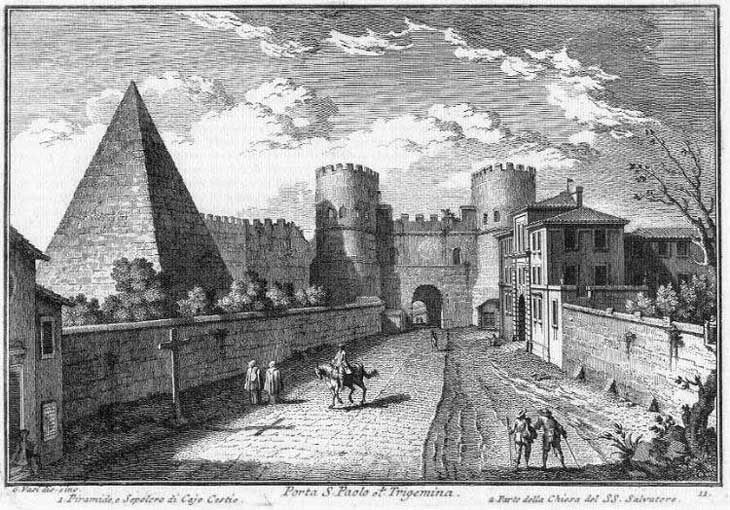
This is an ancient Roman pyramid - which I’d never previously heard of!
This is the Pyramid of Caius Cestius. His tomb.
Built around 18-12BC, so incredibly well preserved.

A lot more information on wikipedia, for example:
A 18th century etching of the pyramid.

✲✲✲

Grafiti.
So much of this trash on Roman buildings. 😡

The Castel Sant'Angelo in Rome

Hi Bloggers,

Just a few photos of us walking by The Ponte Vittorio Emanuele II bridge to get some lunch. 

This was a few days ago.

The Castel Sant’Angelo.
A museum which used to be a fortress and castle.
Didn’t go in ... we were just too tired at this point.
Maybe next time.

Beautiful sight. 
Ducks and birds on the Tiber.

Picturesque.


These are the “winged victories” bronze statues on large columns on the bridge.

We crossed the bridge to the other side and walked a bit...

✲✲✲

The, came to a square.
This is the basilica of San Giovanni Battista dei Fiorentini.
Beautiful building.

 
We then had lunch.
The Pasta In Corso restaurant.
My dish was = prawns, tomatoes and pistachios. Yes, I know!!

I thought this was a great photo shot.

✲✲✲

Roman buses.
They’re so cute.

Caravaggio at the Church of Saint Louis of the French

As part of our trip, we visited the Church of Saint Louis of the French. It is the national church of France in Rome.

Commissioned by Cardinal Giulio de Medici (Pope Clement VII) for the French community in Rome. 

Very special because it holds Caravaggio masterpieces in situ on the life of Saint Matthew.

More information here: Walking Tours of Rome - San Luigi dei Francesi: ​Cappella Contarelli

✲✲✲

The façade and the nave


✲✲✲

The Contarelli Chapel

Named after a French cardinal who died in the 16th century and left instructions for its decoration with scenes from the life of the saint.

The Chapel containing the paintings by Caravaggio.

✲✲✲

The Calling of Saint Matthew by Caravaggio (1599-1600)

Caravaggio’s chiaroscuro floods the painting with dramatic divine light.
The light & finger point accusatively toward Saint Matthew.
The drama heightened by everyone’s confusion.

✲✲✲

The Martyrdom of Saint Matthew by Caravaggio (1599-1600)

A violent death for Saint Matthew.
According to tradition, martyred while celebrating Mass by a soldier.
That soldier is the focus of attention and the contrast between
vulnerability and strength captures the very moment.

✲✲✲

The Inspiration of Saint Matthew by Caravaggio (1602)

An angel guiding Saint Matthew as he writes the Gospel.

This is a second version of the same painting. The first has since been lost:

Caravaggio actually painted two versions of the altarpiece. His first painting was rejected and he was obliged to paint a second version, the work we see today. According to Bellori's account of Caravaggio's life in his book Vite de' Pittori, Scultori et Architetti Moderni (1672), 'the priests took it down saying that the figure with its legs crossed and its feet rudely exposed to the public, had neither decorum nor the appearance of a saint'. The rejected painting was snapped up by Vincenzo Giustiniani, a rich banker and art collector. It ended up in a gallery in Berlin, where, sadly, it perished during the second world war. 

First version.