Sunday, April 13, 2025

“Rembrandt-Hoogstraten: Colour and Illusion” exhibition at the Kunsthistorisches - Part 1: Rembrandt as the teacher; Illusionistic experiments

I was in Vienna in January 2025.

I was very excited to visit the Kunsthistorisches Museum to see its blockbuster exhibition Rembrandt-Hoogstraten: Colour and Illusion.

I have always loved Rembrandt and this exhibition showcased 57 works. There was a wealth of international loans by the master in Austria. 

Ultimately, I found it a beautiful and fascinating dialogue between the Dutch Golden Age master and one of his most successful and innovative students, Samuel van Hoogstraten (who achieved great success at the Habsburg court).

For me, it’s one of the highlight exhibitions of 2025.

Rating: ★★★★★ 5/5

Note: This is part 1 of the write-up. Two more parts to follow.


✲✲✲✲✲

Part 1: Rembrandt as the teacher

The first room introduces us to Rembrandt as teacher (as well as renowned painter, printmaker etc.). He began taking students in Leiden and continued until close to his death. Samuel van Hoogstraten was one of Rembrandt’s most successful students, starting his apprenticeship around 1642/43 at about age 15.

This room explores Van Hoogstraten’s early work which show stylistic and thematic similarities to Rembrandt’s (including creating convincing illusions).

✲✲✲

Self-portrait wearing a Hat and two Chains by Rembrandt (1642-3)

This is how the exhibition opens!

A magnificent self-portrait by Rembrandt. He paints himself courscating. 

Rembrandt captures himself in such splendor - beautiful gold chain & adorned with sumptuous fur. The light makes him glow and shine. I rather like the bulbous nose, slight wispy hair behind his ear, the subtle wrinkles in his the lowered neck.

This self-portrait was made during the time when he was Van Hoogstraten’s teacher. Rembrandt is famous for his many self-portraits - spanning his entire career. 

✲✲✲

Self-Portrait by Hoogstraten (1645)

Van Hoogstraten clearly emulates his master.

The powerful & contrastive use of light, and the central focus of the face.

Like Rembrandt, painted with aplomb - as a courtier with the traditional gold chain

✲✲✲

Self-portrait at a Window by Hoogstraten (1642-3)

I quite like this pen-and-brown ink self-portrait.

Trying to capture the fleeting expression and a sense of depth.

What makes this special is that Rembrandt, apparently, made 3 strokes of his pen to correct the outline of the right arm and shoulder.

✲✲✲

The Holy Family with a Curtain by Rembrandt (1646)

Interesting painting.

Early example of Rembrandt’s experiments with illusionist techniques.

The painted frame with the red curtain is Rembrandt’s pictorial contrivance. The frame is an illusionistic object. 

The fire warms and lights Mary and Baby Jesus. The bond is clear. Joseph is chopping wood in the background and is barely noticeable in the dark.

✲✲✲

St John the Baptist Preaching by Rembrandt (1634-5)

Van Hoogstraten (in his book) praised this particular painting of Rembrandt.

The powers of observation, the extraordinary use of light to focus attention, and compelling depiction of emotions in the crowds.

People in various states - hushing the kids, bored, raised eyebrows...

✲✲✲

Landscape with the Rest on the Flight to Egypt Rembrandt (1647)

Beautiful & moving.

I am reminded of Turner.

A wonderful exploration of light.

This nightscape is the Holy Family’s rest on their flight into Egypt.

Rembrandt’s lambent tones of heat and warmth of colours in fire over the canvass (esp. over the lakes untrammelled surface) creates a wonderful effect.

✲✲✲

Young Man Reading with Vanitas Still Life by Hoogstraten (1644)

Classic vanitas still life of the Golden Dutch Age.

The exhibition compares this one to Rembrandt’s The Holy Family with a Curtain (above).

It was probably made in the middle of his apprenticeship with Rembrandt. The illusionistic depiction of the paper, dramatic lighting, and muted colour palette point to the experience Van Hoogstraten gained during this period.

Painting by Van Hoogstraten — perhaps self-portrait or someone he knew?? Identity remains unknown.

✲✲✲

The Adoration of the Shepherds by Hoogstraten (1647)

Charming beautiful painting in which Van Hoogstraten uses a similar palette and light effects to Rembrandt. The light seems to emanate from Jesus.


✲✲✲✲✲

Part 2: Illusionistic experiments

The next room in the exhibition focuses on Rembrandt as a master of convincing illusions. 

From 1639 onwards, he increasingly experimented with illusionistic effects which warp the boundary between the pictorial space and the viewer’s space — e.g. including barriers, and window and door openings in the foreground of his paintings, which emphasise the presence of the painted figure. He also creates a convincing sense of depth to an otherwise flat space. 

Rembrandt’s illusionistic skills appear to have had a lasting influence on his Van Hoogstraten’s work. The ambitious pupil emulated his teacher in this area (even aiming to outshine him).

✲✲✲

A Woman in Bed (Sarah Awaiting Tobias) by Rembrandt (1647)

A young woman pulls the curtain to the side and seems to gaze at a scene in front of the picture. Her shoulder seems to protrude.

Supposed to represent the biblical story of Sarah waiting for her bridegroom Tobias, on their wedding night. Though Rembrandt leaves room for other interpretations. 

This must have had a striking effect in a home, by candlelight.

✲✲✲

Old Man at a Window by Hoogstraten (1653)

I really love this. Outstanding painting. 

The old man poking his head out of a window and gazing at us. Seems to have a distant look in his eyes.

Van Hoogstraten meticulously portrays the various materials - his looping wrinkles, fine hairs of his beard, soft fur of his hat, hard limestone that frames the window, the glass’s translucency. 

✲✲✲

Girl in a Picture Frame by Rembrandt (1641)

Wow!

Incredible.

It feels like the boundary between the painted world and our reality vanishes!

This girl - in vivid theatrical costume - leans slightly forwards. Her hands touching the painted frame and casting shadows and reflections on it. 

This effective illusionism of Rembrandt had a lasting influence on Van Hoogstraten - as the exhibition makes clear in comparison with his painting below Young Woman at an Open Half-Door.

✲✲✲

Young Woman at an Open Half-Door by Hoogstraten (1645)

Really wonderful.  This painting was inspired by Rembrandt’s illusionism. (And they were side-by-side)

This young woman - looking suspiciously to her side - seems to lean over an open half-door into the viewers’ space.

Van Hoogstraten seems to emulate Rembrandt's protruding fingers over the artificial frame.

✲✲✲

Girl at a Window, “The Kitchen Maid” by Rembrandt (1645)

Love it.

Incredible painting. The girl’s direct gaze is very captivating & charming.

I've seen this painting by Rembrandt before in London, and it has so much charm. Makes you smile. The subdued colours against the shining subject and the shadowing creates a vibrancy to the illusionism. The red cheeks and the white-reflecting tip of her nose.

✲✲✲

Agatha Bas by Rembrandt (1641)

Another wow. Just incredible.

This lady was Agatha Bas. She and her husband had their portraits painted by Rembrandt, as they lived opposite his workshop.

Really very elegantly dressed and with a keen & penetrating gaze at us. She seems to loom out of the darkness and towards us. (As does her fan and left thumb).

✲✲✲

Feigned Letter-Rack Painting by Van Hoogstraten (1667-8)

Terrific illusionism and depth captured by colour variation.

Van Hoogstraten painted this Dutch tradition. While in England, he painted this deceptive array of realistic everyday objects and personal items fixed together with red leather straps against a black background.

There are 21 objects - including comb, letter, scissors, maps, medallion, etc.

✲✲✲

Trompe l’oeil by Van Hoogstraten (1655)

Wow, again.

Van Hoogstraten's illusionistic depiction of ordinary everyday objects is incredible and powerful. The towel looks like you could reach out to take it off the hook. The painting of the wall panelling is so effective too.

This painting has no frame either. So it enhances the illusionism. 

✲✲✲✲✲

✲✲✲✲✲

EXTRA: Me at the gallery, and the central hall at the Kunsthistorisches.


Monday, April 7, 2025

“Discover Constable and the Hay Wain” exhibition at the National Gallery

Back in January, I went to a small exhibition at the National Gallery celebrating John Constable’s iconic The Hay Wain.

Constable and The Hay Wain was a wonderful exploration of this beloved painting, its influences and its legacy. The shortcoming in the exhibition, I felt, was gallery’s maladroit handling of Constable’s non-political art against the purported exegenices of activism in his day. But, this can probably be written-off as a bit of the usual wokeism. 

Overall score: ★★★★ 4/5

✲✲✲

The Hay Wain by John Constable (1821)

Most people reading this may not be aware that John Constable’s wonderful landscape was originally admired in Paris - not England. 

According to the gallery, it sat in a french collection until 1886. It seems that when Constable first exhibited the painting in England, at the Royal Academy of Arts, in 1821, it did not sell. 

The painting was received to great acclaim in the 1824 Paris Salon though, with a gold medal from the king of France, Charles X.

✲✲✲

Part 1 - The Hay Wain as a national icon

1910-20 photo of the house featured in The Hay Wain.

Originally, the house in the painting was the property of a tenant farmer called William Lott. He lived there during Constable’s lifetime. Apparently, he rarely ventured outside his home.

But, by 1925 it had fallen into disrepair. A local MP (Thomas Parkington) then bought the estate and restored the building (as Constable depicted it).

The serene & “prelapsarian” calmness of The Hay Wain has made this picture an enduring cushion to the hurly-burly of modernity. An antidote. A refuge to happier times.

Yet, despite this, I still found myself surprised at just how easily this panorama has become the object of those who wish to agitate and shock us from our supposed apathy, such as:


The Hay Wain has been used by Peter Kennard for the Campaign for Nuclear Disarmament (Haywain with Cruise Missiles). In 2022, Quentin Devine recreated this image to warn about the dangers of the climate change.

✲✲✲

Part 2 - Contextualising landscape painting in Britain

Next the exhibition turns to the subject of land as an “issue of politics”. I.e. - who owned land, the right of common access, restrictions on foreign grain imports (“Corn Laws”) following the Napoleonic Wars resulted in food prices rocketing. 

Ms Christine Riding, curator of the exhibition, takes the view that landscape is political. As such, pictures of agriculture and harvest take on a “new significance” in the context of the era. Some artists wanted to create a picturesque image (inspired by the Dutch & Flemish) and some sought to closely reflect the natural world.

For me, I am not sure I accept the premise that the landscape is necessarily political. It may be; or it may not be. I think it is a bit harsh to judge Constable against these standards. Constable represented a departure from previous landscape paintings. They were very classical and stylised methods which did not necessarily reflect life. Constable only worked from life and made very intense and detailed sketches. His inclusion of peasants and farmers was also revolutionary. His work (alongside JMW Turner) inspired the future French Impressionists and he was highly regarded in France. 

Why should Constable have expressly included the social ills suffered by lower classes in Britain? He wasn’t trying to be the rural equivalent of Hogarth. He wanted to paint something beautiful, that he loved.

Marlingford Grove by John Crome (1815)

John Chrome was used by the National Gallery to illustrate the clear influence of Dutch and Flemish landscape art (light and shade in everyday woodlands) in England’s Norfolk County.

The Coming Storm, Isle of Wight by George Morland (1789)

Another instance of the gallery showing how the Dutch landscape motif had become a regular among British artists (incl. cottage). 

Apparently, George Morland was a particularly popular artist in the earliest years of Constable’s training in London.

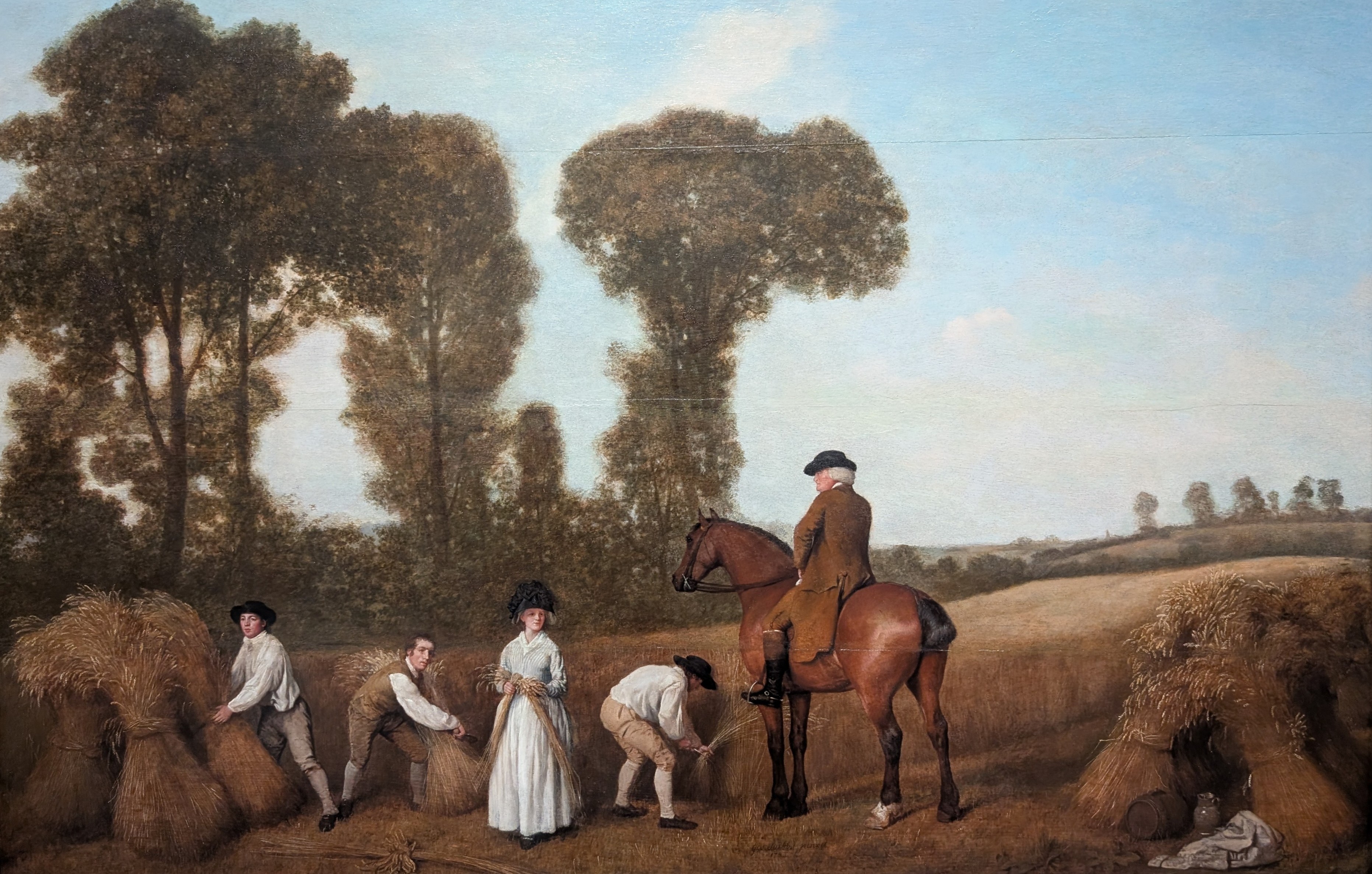
The Reapers by George Stubbs (1783)

Stubbs is already acclaimed for his paintings of horses. 

This painting’s social commentary is quite clear. The relationship between the reapers, who cut and gather the crops, and a gentleman farmer. This while still a picturesque rural subjects (in the Dutch style).

✲✲✲

Part 3 - Making of the Hay Wain

The exhibition shows how Constable built his finished works from sketches, studies and memories of locations he knew and loved.

The Hay Wan depicts the River Stour and the land alongside Batford Mill (which Constable’s father owned). In order to create it, Constable referred to a series of drawings and sketches he had produced over many years beforehand. He made the final painting in his London studio based on these sketches and his own familiarity. 

Both sketches - from 1816 - show the mill stream by Willy Lott’s house
The dog was added in the the earlier sketches.

The National Gallery notes:

At the time Constable made the later study, villagers in nearby East Bergholt were protesting the fencing-off of common land for private use. There is no sense of unrest in this peaceful scene.

As I said earlier, why should Constable paint “unrest” in the painting, when that wasn’t the object sought.

Unfortunately, and especially since the rise of identity politics, highbrow exhibitions, like this one, are expected to condemn antecedents for the insufficient activism and moral impurity to a modern audience.

The Mill Stream by John Constable (1814-15)

Another picture of Constable’s enduring love with his childhood landscape.

The National Gallery have included this beautiful painting of the Mill Pond - but from a position further along the bank. He included similar characters and details to the Hay Wain.

Wonderful.

✲✲✲

Part 4 - After the Hay Wain

I have been to a small exhibition, at the Tate, which explored Constable’s lifelong investigations of the movement of clouds and the effects of light. It’s very interesting, to me, how his painting techniques, in his later works, became “looser” and more expressive (impressionistic).

Salisbury Cathedral from the Bishop’s Ground by John Constable (1823)

A magnificent painting.

The Bishop of Salisbury (and Constable’s friend) commissioned this painting in 1820.

The dark clouds for sense of depth, even crows flying by masts.
Bishop and his wife Dorothea or daughter by the gate.

According to the exhibition:

In his lifetime the artist’s work received mixed responses in Britain. Some viewed his paintings as equal to revered earlier artists, while others felt his approach was unsuccessfully experimental. Following his death, prominent figures such as the art critic and social commentator John Ruskin condemned his style as ‘blundering’ and ‘superficial’. His critical popularity in Britain initially declined as a result. But this changed as his influence on the work of lauded French artists, including Eugène Delacroix and Claude Monet, began to be acknowledged.

Over time Constable came to be viewed as a key figure in British art history. His admirers, collectors and family members helped secure his reputation by ensuring his work entered the collections of major galleries and museums in the UK and beyond.

Sunday, April 6, 2025

La Belle Jardinière by Raphael (1507)

Raphael was born on 6th April 1483 — born 542 years ago. 

This picture is from the Louvre.

What makes the painting so special is the sweetness and tenderness of the glance between the Christ-child and his mother. The cheeks and faces are so engaging, and the shadowing & sfumato so very good. The twisting baby’s stance from Michelangelo and the nudity as a nod to classical antiquity. 

It’s so graceful and with such tenderness. 

✲✲✲

Friday, April 4, 2025

Trump’s mercantilist tariffs

What a joke. Three points to make:

(1) There are reasons, other than financial, for giving help to other countries either via tariff programs or USAID. It is called security. The system of established levies has given the world stability with secure markets. International trade, esp. since World War II, has made the U.S. a phenomenally rich nation. Frankly, until Donald Trump, tariffs were almost always a deranged niche left-wing idea. How did this insanity get into the Republican party?

Even if, for the sake of argument, the tariffs could work in their stated goal of bring manufacturing back to America; they won’t have enough time to work. The pain of the transition will be so great the House will fall to the Democrats in 2026 and the White House will fall to them in 2028. At that point the tariffs will be lifted, if not already. 

(2) No respect or consideration given to alliances. E.g. take Israel. They have almost no tariffs on U.S. goods to begin with. As a gesture of goodwill, the Knesset abolished some few remaining tariffs a few days ago. How was it “reciprocal” to put a 17 percent tax rate on Israeli goods?

(3) Even if I agreed with these tariffs (which I don’t), I am extremely disturbed by the sweeping unilateral authority Trump is claiming under the guise of “emergency powers”. No one man, and his pen, should have this much power over the global economy.

We have to hope that the courts stop him. This is illegal because either (1) setting taxes is an inherently non-delegable legislative function and/or (2) the U.S. trade deficit doesn’t meet the “emergency” threshold definition as the required basis for the order.

Tuesday, April 1, 2025

Reading a new book on the Dutch Golden Age

This is my new book. So exciting.

It’s by Dr Norbert Wolf. It’s about the Dutch Golden Age.

The enlightenment ideals of this period lead to such a wonderful variety of achievements - exploration and trade, economic prosperity, religious freedom and especially art. Also, a period of considerable warfare - the Eighty Years war, the Anglo-Dutch war, Dutch East India Company etc.

The artistic and cultural flourishing in this period is absolutely incredible. The groundbreaking depictions of everyday peasant life and the rustic charm of 17th-century Netherlands is always so meticulous and so very beautifully, such as Jan Steen.

In any gallery I visit, whether it is the flower stills of Dutch painters (e.g., Rachel Ruysch) or the serene and intimate domestic interiors of middle-class life (e.g. Pieter de Hooch) - they are truly phenomenal and show a highly-detailed artistic flourishing.

And of course, we have Vermeer, Rembrandt and Rubens.

So, I will be focusing my future posts on this period, as I go through the book.

:)