This blog is a write up on room 45 of the National Gallery.
The art here focuses on the academic teaching of executing compositions of historical, mythological and religious subjects in the romantic tradition.
The overall Romantic movement - which includes artists like Francisco de Goya, Eugene Delacroix etc. - have a psychological and emotional depth that is evoked. For me, I have always been drawn to the 19th century romantic landscapes (e.g. JMW Turner). It’s art trying to reach the sublime - that sense of awe when observing mankind against the power and majesty of nature shown in grand scale. In Europe, it was partially a response to the Industrial Revolution, and a yearning to return to the “simplicity” of the open-air countryside, a form of escapism. When it comes to people; Francisco de Goya, as a great example, was able to exhibit humanity as a sublime force of its own.
✲✲✲
Monsieur de Norvins by Jean-Auguste-Dominique Ingres (1811)
Interesting.
There is a lot of depth to this painting.
The sitter is Monsieur de Norvins. He was made Chief of Police in Rome in 1811 - when it was painted. I.e. before Napoleon’s fall in 1814.
His face is fascinating; body at an angle, his head and especially the eyes scrutinizes and studies us. Eyes seem to narrow slightly, and his lips closed and pursed, as if to curse. One eyebrow raised just slightly? I love his thick raggedy hair - quite dashing even. Altogether, he strikes me as being a somewhat guarded and even forbidding character. That red ribbon marks him as a Chevalier (Knight) of the Légion d’Honneur, which was the highest French distinction for military and civil accomplishments created by Napoleon.
The vibrancy in the colour is striking and sumptuous. Those 18th century silky-white shirts and neckerchief-cravats really look beautiful against his black greatcoat and opulent silky red-maroon curtains.
According to the NG:
Norvins was a supporter of the Emperor Napoleon – and later wrote a very successful four-volume biography of him – and his political allegiance is shown by the Napoleonic gesture of placing his left hand inside his jacket.
There is a very interesting article which delves into the later-concealed pentimentos of the Napoleonic period. The fall of Napoleon and the shift in power to the Bourbon monarchy meant it was dangerous to exhibit overt loyalties to the former Emperor.
✲✲✲
Don Andrés del Peral by Francisco de Goya (1798)

An engaging portrait - vulnerability and frailty leavened by a certain comfortable elegance.
The languid eyes, grey wispy hair, the left side of his face slightly drooping (perhaps an illness?).
It makes for an intriguing persona. It seems Peral - along with Goya - was employed at the royal court in Madrid. So, they must have known one another.
I am not sure if he’s drawing something out of a pocket though. That’s a classic Napoleon stance.
✲✲✲
The Duke of Wellington by Francisco de Goya (1812-1814)
This is Arthur Wellesley. He was born in Dublin and became the first Duke of Wellington.
I think this painting captures something of Wellington. A certain cautiousness. Alertness. He is certainly not short of military awards.
After defeating Napoleon at Waterloo, the Duke of Wellington purportedly broke down in tears due to the appalling loss of the battle, and didn’t care to be congratulated on his victory.
Here he is depicted after his liberation of Spain from the French at the battle of Salamanca in 1812.
✲✲✲
Portrait of Napoleon Bonaparte by Horace Vernet (1815)
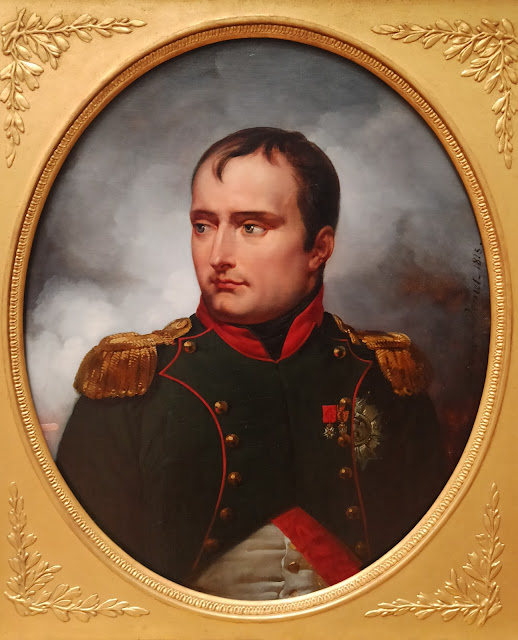
I really do love Napoleon.
The background smoke is apt. Those lone wisps of hair seem a bit peculiar on Napoleon; but Vernet captures a guy who isn’t the most dashing - but has the feel of ‘au destin’.
To me, it’s his rags-to-riches story which is entwined in his legacy.
On the one hand, I know that Napoleon was very careful at curating his own image. He regularly misreported his losses among his men in battles, and frequently exaggerated the losses of his enemies. He was alive at a time when propaganda played a significant role in the upper echelons of military life and around the time of revolution. In other respects he was quite lucky because - by the time he began to rise - the French revolution had killed huge portions of the senior military officers. Also, a common misconception still resonates about Napoleon’s supposed height. But this can be attributed to us, in Britain, pushing the idea that he was short, among other things.
On the other hand, he seems to have been genuinely remarkable - esp. during the time of Romanticism in art. He revolutionized warfare and military leadership through meritocracy and the corps system. Napoleon defeated coalitions of other European major powers - alone - during France’s most extreme tumult & unrest. He lead expeditions to Egypt (giving us all the Rosetta stone), and then coronated himself as emperor.
The romantic fate: where, at the end, he lost everything and was imprisoned on a small island.
✲✲✲
Afternoon in the Tuileries Gardens by Adolph Menzel (1867)

Lovely.
What is very striking to me is how Adolph Menzel can capture the visual aesthetics of a summery French afternoon. Reminds me a bit of impressionism in this Paris gardens.
Adolph Menzel is an artist I don’t know much about. I did a Google search and his other works seem v. beautiful.
Sheer detail: two children playing under their father’s legs, a girl in the back crying, the shadow of the trees’ branches and leaves.
✲✲✲
Rienzi vowing to obtain Justice for his Brother’s Death by William Holman Hunt (1849)
You cannot mistake the subject of this painting.
Cola di Rienzi (1313-54) was a Roman who declared the reestablishment of the Roman Republic. He sought to represent the populace of Rome against the wily machinations of the nobles that dominated the city. Here, his youthful and indomitable spirit is clear. Clinched fist, youthful champion of the peoples against the barons; only to be counterposed by the horses’ backsides against them.
The brother as blond and youthful, innocent-like, with wreath of flowers in his hand. Strange that the brother is the only one furious. The other soldiers - towards the fore - merely observe nonchalantly and whisper to themselves.
Signifying the end of innocence?
✲✲✲
Evening on the Lake by Camille Corot (1872)
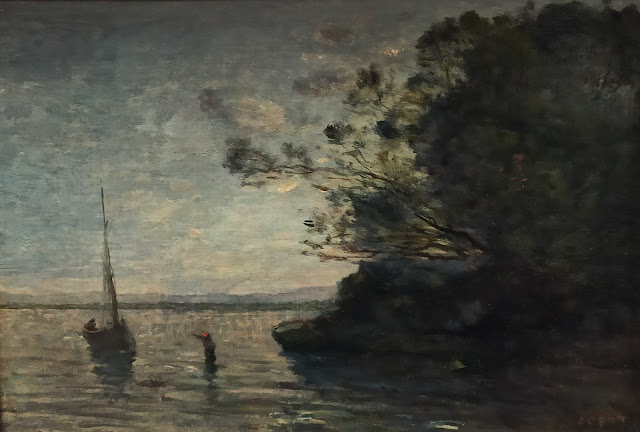
Evokes the quiet, gloomy and elegiac.
The unwinding of a lovely sunny afternoon (boat coming into shore) - with its inherent nostalgia - as the sun sets, and darkness creeps in. I really do love the calm & unruffled waves painted across this lake and its shimmering reflections.
It’s unsettling a bit; and a bit peaceful.
I like that red dot, a red chapeau on the fisherman’s head?
I think we can see Corot’s influence on impressionists and the en plein air style. I remember he was Berthe Morisot’s art teacher.
✲✲✲
Alders by Charles-Francois Daubigny (1872)
Another of the French en plein air artistic landscape group.
The colour palate perfectly captures a calm warm evening.
There is a woman in a red/white hat towards the centre, and I really like those cute ducks.
On closer inspection, the painting has many layers of paint.
✲✲✲
Salisbury Cathedral and Leadenhall from the River Avon by John Constable (1820)
Amazing.
I think Salisbury Cathedral, whose spire can be seen rising above the trees, was a recurring theme.
Constable painted the British countrysides and British landscapes to blur out the noise, steam and smoke - leaving us with the most idyllic, emotional and personal landscapes.
I often go into the Tate and the National Gallery and find myself gazing at Constables - with old couples around me - sighing at our beautiful countryside.
I really love Turner whose work amazes and inspires but, I think, perhaps, Constable soothes the viewer the most.
✲✲✲
Weymouth Bay: Bowleaze Cove and Jordan Hill by John Constable (1816-1817)

This view is Bowleaze Cove in Dorset.
This painting is incomplete, but quite pretty. But I do think it may be missing something?
The thick heavy clouds match the crashing waves rolling onto the breach.
✲✲✲
Portrait of Louis-Auguste Schwiter by Eugène Delacroix (1826-1827)
This photo doesn’t do the portrait full justice.
I quite like the affected and distinct elegance in his clothing, posture and manner. There is a certain “oh hello, didn’t see you there” look in his face.
From Jonathan Jones:
Schwiter is a dandy: an exquisite, thin and tall to the point of caricature. He wears one calfskin glove and delicately holds the other along with a hat with a silk interior. His high collar sets off a face that is haughty and full of savoir faire, for all the unkempt windswept romanticism of his hair. He is a man letting nature - which falls away behind him - permeate his being while remaining self-aware.
It is said that the landscape background was painted by Delacroix’s friend Paul Huet, but it is Delacroix’s intoxicating sense of colour that sets this picture alight. It’s in the weird shimmering blue of the ceramic vase, in the tender starbursts of the flowers exploding in the vegetation and, above all, in the placing of a man in a deep black suit against a stone balustrade, which seems to prop him up, as if he were a delicate flower.
Delacroix submitted this portrait to the Salon exhibition of 1827; it was rejected. He later repainted parts of it. This was a time when he was particularly interested in dandyism, in the figure of the artist as at once active and passive, enthusiastic and bored, heroic and anti-heroic. In other words he had been reading Byron.
This portrait is Byronic. Schwiter feasts, not on rapine and slaughter, but on sublime landscapes like the one that surrounds him; yet his delight in landscape is, like that of the bored Sardanapalus, somehow disengaged.
✲✲✲
The Lower Falls of the Labrofoss by Johan Christian Dahl (1827)
Pretty good.
We’re shown the rugged wilderness.

There is a small wooden hut to the side. There is an intensity and power to the white rapids cascading over the rocks in the torrent.
In the background, tall pine tree are silhouetted against the darkening violet-blue-tinted sky.
✲✲✲
The Northern Drawbridge to the Citadel in Copenhagen by Christen Købke (1837)
Very charming, I think, with something nostalgic.
I really love the NG’s Christen Kobke paintings.
The citadel is a military fort. Soldiers fishing by the stream. One soldier standing sentry. The fading tint of the skyline (from light blue to pink) gives the painting a relaxed captivating evening atmosphere.
Above all, I am really drawn by the marvellously intricate & accurate drawbridge structure. Its precision, elegance and distinct blush-colour focuses the attention. And then, there is that slouched gentleman relaxing with his arm on the railing. That casual and easygoing feeling of a summer’s evening.
According to the gallery, this spot was important to Kobke:
Kobke’s father ran the bakery in the Citadel until 1833, when the family moved away from Copenhagen. Kobke probably painted this for his mother as a souvenir of her former home.
✲✲✲
Portrait of P. Ryder, Son of the Artist’s Cousin, by Christen Købke (1848)
Love it.
Really captivating portrait of a master baker. The subject is Kobke’s cousin’s son.
I love the fact that it seeks to affect an unpretentious and plain subject (despite being the artist’s intention). I like the relaxed homely pose as this chap smokes his cigar (or cigarillo) on the wooden bench. I love the way his hat is pulled back, and his engaging eyes. His working clothes are simple, perhaps a bit tight downstairs (!!).
I like the fact that his hand and knuckles have a certain reddish complexion while the rest of the skin is much whiter. Amazing.
He has a basket of pretzels ready behind him - in case we weren’t sure what he does.
✲✲✲
Portrait of Wilhelm Bendz by Christen Købke (1830)
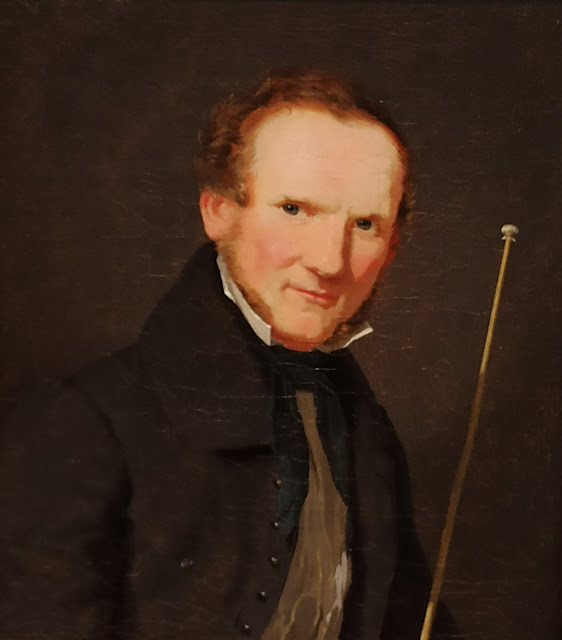
Interesting portrait. (Though not the best photo taken!)
The subject is Wilhelm Bendz who was “one of the most talented artists of the generation”.
The stick is a “maulstick” which would have been used to support his hand while painting. I like the way he leans towards us inquisitvely, as if we’ve interrupted him at his art work.
The tint of reddishness in the cheeks is remarkable.
✲✲✲
Portrait of the Comtesse Vilain XIIII and her Daughter by Jacques-Louis David (1816)
I really like this portraiture - especially the subtle affection between the mother and her daughter.
The Comtesse and her daughter (Marie-Louise) are contrasted. The seated Comtesse seems stolid and contemplative. Her eyes seem to betray someone in deep thought looking into the distance.

Her daughter, by contrasted, seems to be meeting our gaze and trying to “affect” a smile in a way that children sometimes do when being photographed. She’s holding onto her mother’s hands in a very sweet way.
The vivid colours in the cloak around the chair and the dress are really vivid against the empty hollow background.
This was painted in 1816 which was David was in exile in Brussels following the fall of Napoleon. And, like David, the Comtesse Vilain XIIII was connected to the Napoleonic cause. I wonder if that accounts for the mother’s wandering look?
✲✲✲
The Friedrichsgracht by Eduard Gaertner (1845)
This is quite an interesting composition and quite beautiful.
To me, the geometric and precise architecture and structures make for a very appealing work. The zinc roof - at the fore - looks really beautiful in its minimal exactness and lines.
As per the NG, he was referred to as the ‘the Prussian Canaletto’:
Gaertner’s style is naturalistic and precise, his scenes resembling snapshots of the everyday life of the city but also reflecting a preoccupation with atmosphere and light that has led to him being called ‘the Prussian Canaletto’.


