Friday, October 20, 2023

Review: The Nun II – a great horror flick

Earlier this week, I watched ‘The Nun II’ at the cinema (which wasn’t cheap even with student discount).

It was really very good.

The film is based on 1950s France and involves a demon trying to return to power and terrorising the students and staff of a school. Called into action by the Catholic Church is Sister Irene goes to defeated Valek. It is both mystery and horror. I have to say the terror in the opening scene was shocking and set an ominous tone to the film. I strapped myself in. 

The film was v. visually atmospheric with a wonderful wardrobe, an oak-barrel winery, motorcars, visceral horror elements and creepy noises - especially the scene with the newsstand in a dark cobbled alleyway. Very stylish, perhaps more so than horror.

The acting and casting was impressive. The characters’ chemistry and connection were really examined in this film. Horror films sometimes prioritize scare scenes and creepy/eerie atmosphere over an emotional depth to the film. I especially liked how the subtle and unforced the romantic subplot was developed and their obvious chemistry among the protagonists.

I wish the film wouldn’t turned the Church and theology into a Marvel movie though. The fact is that a nun cannot really be an exorcist. Catholic priests have the authority which a Bishop has to sanction. St. Catherine of Siena was known to have exorcised demons. That would put Sister Irene on par with a Saint! Also, it is unclear why the demon has to hunt for a relic to obtain its ‘powers’. That backstory is never fully explained despite serving as the fulcrum to the film’s entire story-line. And it was clever to have the demon defeated through the eucharist; but those barrels of wine were a bit silly.

Something else that doesn’t sit well with me is how ‘The Nun II’ veers into adventure-action type of horror (rather like Tom Cruise’s ‘The Mummy’). It is strange that a demonic entity has to be give chase, fight and seems to be foiled by hiding under a table - but, at elsewhere in the film, can snap a girl’s neck with a flick of her hand.

Overall, it is a v. enjoyable and scary film. Totally recommend.

7/10.

The growing antisemitism following Hamas conflict on October 7

I've been a v. alarmed at the levels of Israelophobia and antisemitism on display in the UK following October 7. I am worried for conflict in Britain's communities, and I'm v. disturbed at the nasty recrudescence of mobs and hatreds.

This post is a few things that have stood out over the past week or so. 

✲✲✲

1. Last week, the BBC declined to call the unspeakable acts of barbarism and evil on some 1400 Israeli citizens (and other nationals) as a "terror attack", or those who perpetrated it as "terrorists". John Simpson has defended the broadcasters policy going back to WW2 and their disinclination to refer to the Nazis as evil or wicked etc. Fair point, but I think certain words - like terrorism - really should retain their force to describe certain events. People can be convicted on terrorism offences, and Hamas is proscribed as a terrorist organisation. This terrorism is being funded by Iran and its antisemitic proxies; and has nothing to do with Palestinians. The BBC should speak plainly.

There is an excellent article by Vernon Bogdanor about Hamas being a group dedicated to killing Jews:

✲✲✲

2. There was an interesting article on the eruption of Jewish-Israeli-hatreds across the world (especially in England) when they're at their lowest by Madeline Grant. Including the Sydney Opera House, and their embassies. From the BBC, the pulling down of the flag of Israel days after it was raised above Sheffield town hall in solidarity with the massacred victims of Hamas, is symptomatic of this boiling culture.


Mob brown-shirts have been in our streets apparently support of the pogrom against Jewish people. A stark contrast to dignity Jewish street vigils.

✲✲✲

3. Some double standards on the Western response to Israel's actions.

People have been talking about the appalling devastation in Gaza and the suffering of the civilian population - but not about Hamas safely in their tunnels etc. Journalists have been frequently claiming that Israel's reaction to Hamas's terrorist attack is disproportionate. But, who cares to explain what is the 'proportionate response' to a savage enemy that hides behind the civilian population and whose sole aim is to destroy Israel and butcher its citizens. Then, there was that outrageous letter from the jokers at the "Artists for Palestine UK" (incl. Steve Coogan, Charles Dance, and Tilda Swinton) calling for Gaza ceasefire but failed to mention the terror attacks.

While our Prime Minister has taken a strong and balanced stance on the war; it is interesting to have seen the anti-Israel bias in the media this week. When that rocket hit a hospital car park in Gaza, everyone jumped on the bandwagon and it was quickly reported by some of our big media - incl. Reuters & BBC - as being caused by the IDF. Many were only too willing to believe. Within 24 hours it was obvious that the faulty rocket had been fired by the terrorist within Gaza. (Some 450 rockets, aimed at Israelis, have landed short and fallen into Gaza, since war broke according to the IDF. As Bogdanor wrote above, Hamas is the enemy of the Palestinians themselves). The problem? Passions - already red hot - become inflamed. People don't notice the corrections and the original headlines morphs a destructive fiction.

✲✲✲

Update 23.10.2023 – There has been an excellent column in this week's Sunday Telegraph examining the BBC's moral quandary by Mr Danny Cohen. With regards to the awful reportage on the Al-Ahli Hospital and the unwillingness to properly define the pogrom of Oct 7th ... he has diagnosed this malady as an anti-Jewish sentiment within our institutions:

On multiple platforms the BBC had blamed Israel before the facts were known and other media organisations picked up their line. Across the world people believed Israel was responsible for the bombing of a hospital. More anti-Semitic violence and anger followed, from riots in several cities in the Middle East to the cancellation of a series of crucial diplomatic meetings with Arab leaders that had been planned by US President Biden.

The thing is mistakes happen once, maybe twice. When they happen multiple times they are not mistakes. They are institutional fault lines which reveal bias and deep-rooted prejudice. And this takes us to the heart of the issue. Again and again, the BBC seems to have a problem when it comes to the Jewish State and by extension the Jewish community. The organisation has form

The BBC must therefore urgently ask itself the following questions. What are the institutional biases which mean that this keeps happening? What is it about its reporting which consistently leads to these failures? Is it prepared to undertake the challenging level of self-examination required to really get to grips with the anti-Israel bias that has existed at the BBC for far too long?

[...]

Since Hamas attacked Israel just a few days ago Jewish schoolchildren in the UK have been advised to hide any signs of their religion on the way to school. Antisemitic incidents in the UK have increased by over 1300%.

It is a terrible indictment that our national broadcaster is only making this problem worse.


Lady Justice Simler, the Supreme Court and diversity

Lady Justice Simler has been appointed to the Supreme Court.

It was accompanied, as the FT has written, by a complaint of sorts from the Supreme Court about its diversity:

The Supreme Court acknowledged criticisms over the UK judiciary’s record on diversity as it announced Simler’s appointment. She is only the fifth female justice appointed since the UK’s top court was set up in its current form in 2009.
"We know that certain people, including women, black, Asian, and other ethnic minority groups, and disabled lawyers continue to be under-represented in the judiciary," the Supreme Court said.
"Progress is being made but more needs to be done to increase the pace of change," it added.

I think this is misguided for the following reasons:

  1. Appointment to the Supreme Court is not a normal job - like an airline pilot etc. It is an extremely influential job and there is a v. limited pool of candidates because you need to have been an outstanding practitioner for 25+ years. You cannot call up some recruitment firm to send over some diverse candidates to virtue signal to the present cultural zeitgeist.
  2. Our House of Lords/Supreme Court has, until recently, come from people born no later than 1962. The youngest Justice is Lord Sales. During that historical period, the population of England/Wales/Scotland has been almost unanimously white. Thus, it is no surprise that the Law Lords and Justices have thus been unanimously white. Also, no surprise that men - from that era - were more willing than women to diminish their family and social lives for career success.
  3. Women were excluded in the past in the law and things changed as the decades rolled. Women today can compete on an equal footing with men. Lady Hale, Lady Arden, Lady Black and Lady Rose all attest to this. Should a female judge from the Court of Appeal apply for a Supreme Court position, their application would be treated fairly today. As I mentioned above, there can be no discrimination at the JAC. The Supreme Court's own site highlights that appointment is on merit.
  4. A selection criteria focused on 'diversity' is illegal under The Equality Act 2010. I also think immoral. Diversity has no relevance to merit.
  5. Lastly, we don't want to be in a situation where, as an example, a black woman sitting on the Supreme Court might ask herself "Am I here on merit, or am I here to fill a quota?".

Thursday, October 19, 2023

More Impressionism and Post-Impressionism at the National Gallery

This post is about some of the changes, rotations, loans and new acquisitions to rooms 43 and 44 at the National Gallery.

✲✲✲

The Petit Bras of the Seine by Claude Monet

Lovely.

I think there is something quite special and striking about poplars against a solemn landscape and calm riverbank.

This is not the first time Monet has captured Poplars.

I really love the way the river gently curves towards the empty horizon.

✲✲✲

Eva Gonzales by Edouard Manet

This the painter Eva Gonzales. She was Manet’s model and then his student.

She has those lovely rich curls, her marble complexion, engaging features; but that elegant satin gossamery dress is just so beautiful. I’m always amazed at how artists - like Manet - can make the folds of a dress look so delicate, like the feathers of a dove.

I also noticed those flowers on the floor. It’s probably form the vase she’s observing in the painting.

Gentle white brushstrokes, feather-like texture.
Painting within a painting.

✲✲✲

Portrait of Elena Carafa by Edgar Degas

I like the pose, and the direct gaze.

Elena Carafa was Degas’ cousin from Italy.

I do like the inclined angle towards the viewer, her nose is rather cute, and those keen and perceptive eyes. Her general face is a bit inscrutable though. It’s as though we’ve interrupted her reading.

It’s also nice the way her shawl melts into her black dress.

✲✲✲

Portrait of Carolus-Duran by Edouard Manet

This is Manet’s fellow artist Carolus-Duran. He reminds me of TinTin, which makes me smile.

Cap-off, hand-on-waist, riding boots, the confident swagger, slight hint of a contented smile, thick wavy hair ... it has the feel of those great stately portraiture.

I think this painting is unfinished.

✲✲✲

Ballet Dancers by Degas

Degas’ ballet dancers is just so beautiful.

If someone described a Degas painting to you, you’d picture some treacly cliche over a kitchen’s table in a typical lovely Auntie’s house. Instead, in Degas, there is an expressive force and weight to the figures matched by the grace and fluency of their interactions .

The vibrancy of his colours is also very striking and distinctive. It has, I think, a darker palette.

I love the way we can feel the texture of the canvas beneath ... that coarseness.

✲✲✲

Lake Keitele by Akseli Gallen-Kallela - 1905

This is quite interesting.

Akseli Gallen-Kallela was a Finnish artist, and here he painted Lake Keitele.

There is something mystical and ethereal about this painting. Those ridiculously long shadows of the island in the water, the untrammelled waters, the silvery streaks crisscrossing and dissecting the painting.

It’s also hard to tell what those white forms are across the water, perhaps some clouds but they doesn’t seem correspond. Perhaps something symbolic?

✲✲✲

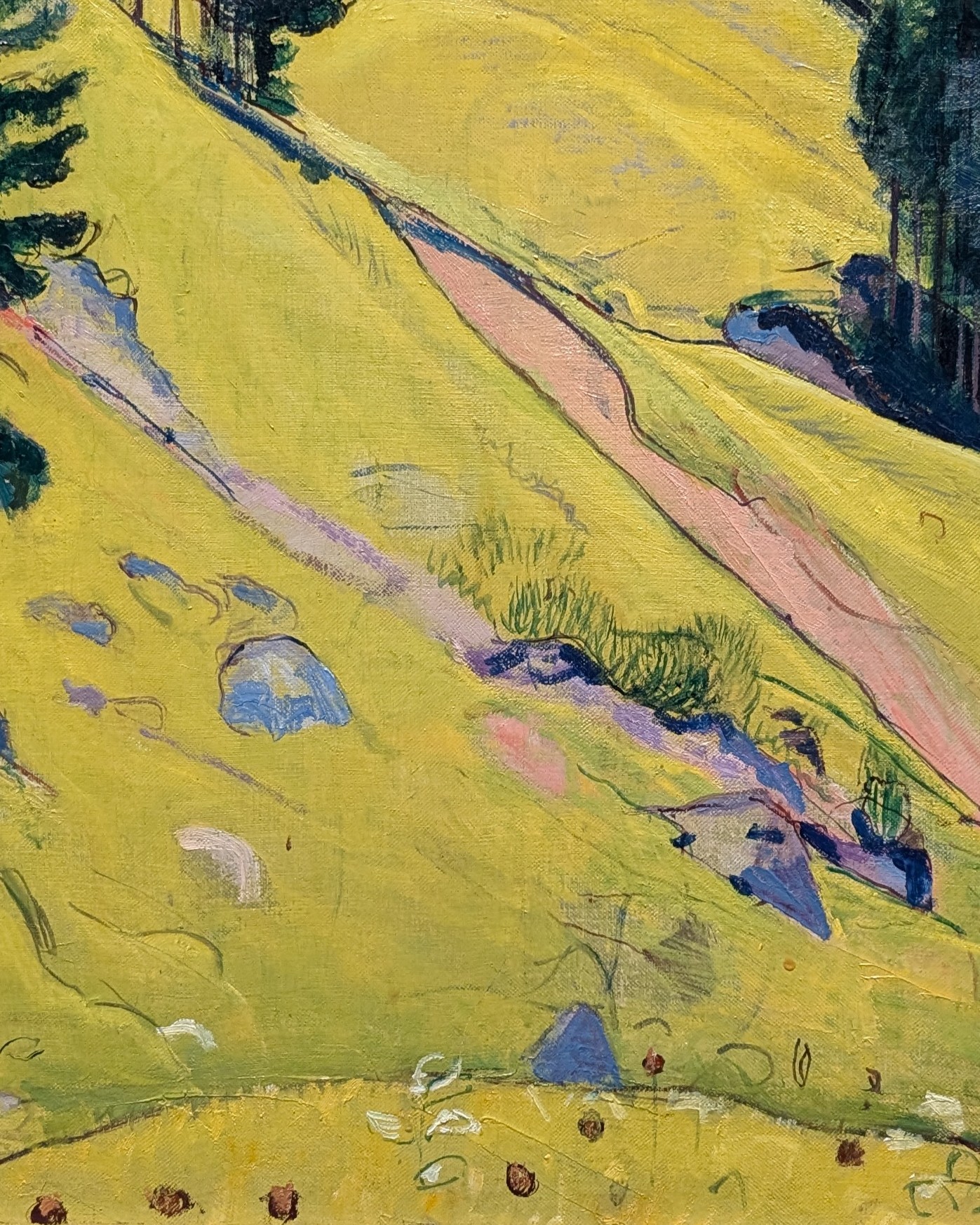
The Kien Valley with the Bluemlisalp massif by Ferdinand Hodler

Love it.

Reminds me of Gauguin and we can see the Japanese wood-prints influence. But I’m not sure what I think of this.

Its clear Hodler’s imbuing the landscape with emotion and a striking colour (which is v. effective). The Alps are rendered a commanding and meditative force. Quite beautiful.

Life is made cartoon-like and ornamental in the sea of yellow.

✲✲✲

In the Bibemus Quarry by Cezanne

So beautiful.

This is supposed to be a quarry but Cezanne almost gives us the inside of a flower. The quarry walls being petals opening up.

I love the way the brown-orangey-rust colours melt as rock layers in an escarpment.

Human figure, with his hat on, and coat on shoulder ... striding forth.

✲✲✲

Woman in the Garden by Henri de Toulouse-Lautrec

I like it.

It reminds me of Toulouse-Lautrec’s painting of Tristan Bernard.

Nice brushwork that creates texture for the lady’s clothes and the green foliage.

I also like the nose and lips on the young woman’s profile.

✲✲✲

La Terrasse at Vasouy, The Lunch, Part 1 by Edouard Vuillard

Vuillard gives us a wonderful summer fete.

This is supposed to be his friends eating outside with Paris literary and artistic circles.

Vuillard’s colours are incredible - so raw and yet so harmonious.


It doesn’t feel like this was painted on a canvass ... more like a slab of concrete!

We can really appreciate his wonderful impasto.

✲✲✲

La Terrasse at Vasouy, The Lunch, Part 2 by Edouard Vuillard

Just beautiful.

This painting was originally part of a single decorative panel (with the above painting).

Two little sweethearts being tended by a nurse in such a summery garden. I love the nurse’s hat; and those clouds have an amazing billowing texture and hue.


Some more impasto shots.

✲✲✲

Still Life with Water Jug by Cezanne

Another classic Cezanne - but unfinished.

Depicting a blue water jug and a plate with apples. The way the apples meld into and with the surfaces!

✲✲✲

Avenue at Chantilly by Cezanne

I really do like these type of Cezanne paintings. It doesn’t feel like these is much on the canvass; but a lot is carried here.

Interesting use of space and perspective. Looks like two openings. One to the clouds and the other to the red sphere (a sun?). I like interplay of the greeny foliage against the shadowy floor and the orange sandy middle.

It’s very beautiful.

Cezanne spent a few months in the north of France, around Chantilly.

✲✲✲

Harvest: Le Pouldu by Paul Gauguin

Interesting.

The thing about Gauguin is that the landscape and characters obey a simplified geometry and form; against which is defined blocks of basic colours. For instance, the sea (in the background) doesn’t really seem to obey the conventions of linear perspective. It feels a bit strange, curtain-like.

I often feel that there is an undertone of darkness in Gauguin’s paintings. Some kind of struggle which he seeks to capture. For instance, I didn’t really warm to ‘The Wave’ and ‘Nevermore’ (which I discussed at the ‘After Impressionism’ exhibition at the National Gallery). Though they are masterful.

For me, there is a subdued warmth in the colours - especially in the harvest - which accentuates this peasant community’s toil.

That poor lady’s bearing.

✲✲✲

Fruit Dish, Bottle and Violin by Picasso (1914)

A nice analytic drawing that cuts across structure and viewpoint.

I like Picasso’s encouragement, to us, to look at life through his unique lenses; but but I sometimes struggle to understand what Picasso is trying to teach us here about his perspective on life. Picasso didn’t see his furniture, bowls of fruit, bottle, violin in collapsed or cubist sharp lines and edges.

For me, when I see this kind of painting, I think its a clever illusion. Picasso is a visionary master of technical skill, but it’s hit-and-miss with me and Picasso. Sometimes I really like his paintings; but other time I struggle to see him communicate something profound.

But hey-ho. We’re all different.

Saturday, October 14, 2023

The Hamas Oct-7 attack

Israel at war

I would like to post about the shocking and horrific attack Israel has recently sustained; and a broader note on the law regarding Israel’s war.

I think we should be under no illusion as to why the terrorists of Hamas suddenly decided to wage an all-round offensive against Israel. And the word ‘offensive’ doesn’t quite capture the evil and carnage visited on ordinary Israelis. How anyone can riddle babies with bullets, burn young people alive in their cars etc. is beyond my comprehension.

I am v. glad that the British and American governments have been steadfast in their support of the Israelis in the face of this barbarism. Especially since we now know that Tehran were complicit in Hamas’s plan and were probably seeking to pivot a Middle Eastern conflagration. 

Today, the reality is that Israel is at war.

Richard Kemp (see below) has recently argued that the war must be fought with overwhelming force against Hamas - or risk embroiling into an interminable war with more dead bodies on either side. That seems correct to me. What will prove problematic and thorny is how Israel responds to this appalling act of aggression.

The laws of war

Under the norms and rules that govern warfare in international law (the law of armed conflict), states have a right of self-defence against an armed attack; and, accordingly, Israel has a broad military latitude. This is qualified by the need for force to be necessary and proportionate. Proportionality entails the defending state deploying as much force as is necessary to neutralise a threat – and no more. The unprecedented scale and nature of Hamas’s attack means that Israel easily satisfies that broad discretion. The question would be the proportionality.

The crux of the problem is how do you fight an organised and monstrous terrorist campaign seeking to butcher and rape civilians and murder babies – and, most notably, use the Gaza citizens as a veritable human shield. How does a modern-day democracy, like Israel, respond to an opportunist cynical attacker that won’t fight in an open battlefield?

There is a world of difference between murdering civilians, and parading their defiled corpses through town; and targeting terrorist cells (and necessarily inflicting collateral damage). The difference is the intent; and this is recognised in law. For example, the Obama administration had to use the same principle with its drone strike program when targeting terrorists (e.g. Anwar al-Awlaki). Ordinary citizens – incl. many in numbers – can be killed if a military operation is necessary and proportionate with reference to the military advantage anticipated.

Israel’s missile targeting is lawful if it meets the test (in the above paragraph) which is measured against the serious and pressing threat which is capable of striking most of Israel (as the Hamas’s large rocket force is evidently capable of doing).

To my mind, the heavy bombardments of Gaza represents a shift in military strategy. In the former military engagements, the bombardments of Gaza ended-up with the terrorist group remaining in power. I suspect Mr Netanyahu has opted to destroy Hamas’s military and governing structure through targeting whole Gaza neighbourhoods - as opposed to individual buildings. Hence, the warnings have changed.

This may sound and feel like Dresden during WWII; but I am not sure that Israel has much meaningful alternative. Hamas have always operated in civilian buildings. The rules of war - that most people are familiar with - were not designed to deal with military engagement in urban cities and against a ruthless adversary. For me, it was very revealing that after Israel called on the 1.1m Gaza denizens to move South; Hamas then immediately rebuked those civilians and urged them to ignore the call. Indeed, the warning itself can be tricky. Traditionally, the IDF used to give prior warning for certain strikes - but that can only come at the expense of losing the military advantage of the surprise which may be critical. 

People have been criticising the severity of the blockade and the turning-off power in certain parts of the Gaza Strip. But the object is to free hostages that have been kidnaped, and of course Israel is at war. The electricity has been cut in areas clearly controlled by Hamas (i.e. not the evacuation zone), and to which they (Hamas) will use it (electricity) to further attacks on Israel. Indeed, Israel has also been negotiating certain supplies entering via Egypt at the Rafah crossing. The blockade and power cut - which can feel excessive - can probably be justified on the above analysis. Blockades are not a novelty in wars.

At the end of the day, Israel is at war and is entitled to eliminate Hamas. The problem is that the military cannot veer towards revenge. US Senator Lindsey Graham has been quoted in yesterday’s paper as saying that Israel should “raze” Gaza to the ground. This is ridiculous nonsense which would should embarrass any democratic constitution. It’s what separates a military structure in a democracy from barbarism, and it is precisely why the Geneva Conventions were introduced. 

Notwithstanding the absolute horror at the recent slaughter in Israel, I really do feel for the ordinary Palestinians too, and their terrifying situation. Hamas are maniacs and will (and indeed, do) easily kill their fellow Gazans who disobey their orders.

✲✲✲

Richard Kemp in The Daily Telegraph:

“Tunnelling and a ban on electronic comms gave Hamas advantage”, in The Daily Telegraph.