Saturday, August 5, 2023

Human-Headed Winged Lion (Lamassu) by Ancient Assyrians (883-859 BC)

Part of my visit to the British Museum is my plan to study the art of the ancient civilizations.

The Assyrians are an ancient civilization. I knew a friend at Cambridge who studied assyriology. They covered Mesopotamian and eventually into Syria, Armenia and Egypt itself. They sacked Thebes around 1500 BC. Their civilization ended with the destruction of Nineveh (their capital) in northern Mesopotamia around 612 BC.

✲✲✲

The colossal Lammassu of Assyria

Their art is principally focused on the glorification of their absolute monarch.


(The head piece is "Ashurbanipal king of the world, king of Assyria". The colossal human-headed winged bulls (Lammassu) guarded the entry to the Assyrian palaces (see here), especially at Khorsabad (excavated at Nimrud) and each had 5 legs.)

Pretty amazing carvings. The winged bulls are very imposing and beautiful. Lammassu is a clear representation of the Kin: wings of the eagle, strength of the bull, brain of man.

✲✲✲

Wall relief at the Royal Palace of Nineveh depicting Ashurbanipal's lion-hunt

The early Assyrian art has been lost, it seems; but the later Assyrians had access to plentiful durable stone for low relief carving.

The Assyrian relief sculptural highpoint was the decoration of the palace at Nineveh of King Ashurbanipal. The continuous processional reliefs at Nineveh lined the approach to the throne room of a length of more than 100m. The slaying of lions was a ritual reserved for the king only. Lions were quite common in those days and a terror of the village-folk. It was a betokening demonstration of the King's power.


These were absolutely stunning in person. A fascinating window into an ancient history.

The craftsmanship is mind-blowing; I think more impressive than the Elgin Marbles.

What is striking is sheer visceral naturalism in the scenes of bloodshed and agony. I wonder whether this degree of naturalism is found generally in Mesopotamian art.

Review: The Elephant Man (1980) – a tragic and moving masterpiece

I've just finished watching The Elephant Man. My goodness! What a moving evocative film.

It is incredible how - despite John "Joseph" Merrick being the object of such despairing cruelty and nastiness among his coeval - he still managed to maintain some positivity, decency, affability and cheer in his life. Although the film exhibits the worst of human nature, it is also full of the compassion and the generosity of the human spirit.

This movie is genius, in certain respects. An incredible cast of England's finest knights: Sir Anthony Hopkins, the late Sir Johns Hurt (I met him once!) and the imperishable Sir John Gielgud. Including, an amazing turn by Freddie Jones. Also, a very touching performance by Kenny Baker (guy inside R2-D2). The cinematography is brilliant and the makeup effects are pretty impressive. I found the first 10 minutes of the film quite experimental in story telling - flashes of stressful childbirth and an elephant. The adagio for strings is very powerful. No CGI here which gives the film that wonderful sense of authenticity - much needed today. The film's setting and backdrops are full of amazing details creating an immersive feel. The black-and-white film really transports us to a different epoch. In short, a remarkable combination of pure talent creates a tragic, dark and unforgettable film.

I liked how Anthony Hopkins' character - Dr Frederick Treves - wipes away the begrime and allows Merrick's wonderful personality and intelligence to shine. Merrick ultimately finds some solace against his tormentors & defamers. The heart-wrenching scenes of the morons breaking into his room and pushing him around and pouring alcohol on him: it's manifest who the true monsters are. Nevertheless, Merrick's amor-proper and pride - gradually scaffolded up by his doctor friend - surpasses the inherent anxiety and fears of the general public. He learns a bit how to annunciation and speak; and he becomes fascinated by civilized society and theatre. Because of his deformity, he can't even sleep like normal people. I really love how John dresses himself - takes such special pride in his clothes & appearance to match his kind gentle manner. 

John Hurt was incredible as John Merrick. The painful nuances in the physical movements, and I could feel the discomfort in Merrick's speaking and breathing. The acting really transports you. You kind of forget that it isn't the real Merrick. 

Then, there is the deeply touching Romeo and Juliet scene. Anne Bancroft here is incredible. Her character, Mrs Kendal, decides to visit Merrick. As a leading actress, she decides to read some Shakespeare; and soon they are both reading the beautiful passages. For the briefest of moments - through the magic of theatre - Merrick becomes Romeo - our hero - and we can see that. We get to see his great courage and strength in the face of such adversity, and his benevolent and kind nature, and his beautiful soul. It is a very powerful scene that made me tear up. (Then, there are the scenes of him speaking about his mother with such warmth and love. They killed me too.)

It's an inspiring story.

✲✲✲

Note: doing some research online, it seems Merrick used to quote poetry in his correspondences.

"Tis true my form is something odd, But blaming me is blaming God; 
Could I create myself anew I would not fail in pleasing you.
If I could reach from pole to pole Or grasp the ocean with a span,
 
I would be measured by the soul; The mind's the standard of the man."
— poem used by Joseph Merrick to end his letters, adapted from "False Greatness" by Isaac Watts.

Friday, August 4, 2023

Turner gallery revisited - Part 4 - Turner's travels in Europe

Note: This blog is a continuation of my visit to the Turner gallery on the 26th of July.

This room in the gallery is about Europe as Turner saw and imagined it. The Revolutionary and Napoleonic Wars (1793-1815) prevented Turner from travelling freely. From 1817, Turner travelled to France, Belgium, Netherlands, Germany, Denmark, and especially Italy. 

It has only 5 paintings which I hadn’t covered before: Turner’s Europe.

✲✲✲

The Dogano, San Giorgio, Citella, from the Steps of the Europa by J.M.W. Turner (1842)

Turner, The Dogano, San Giorgio, Citella, from the Steps of the Europa

Spectacular. A billet-doux to Venice.

When Turner paints such an adorned vista, life itself becomes buoyed and suspended.

The tranquillity and serenity lent by the ever-so light fretting of the surface of the water. The imposing architecture (esp. San Giorgio Maggiore) and the gondolas allows for an ephemeral reflection which adds to the painting’s beguiling surface shape and geometry. As ever, the interaction between the skyline and the sea allows for them to interact & meld in Turner’s paintings.

Some details:


I really love this little sketch of someone oaring the gondola. A charming embellishment. And, even more sweetness: two little pups at the lower right-hand.

✲✲✲

The Bridge of Sighs by J.M.W. Turner (1840)

Turner, The Bridge of Sighs

One of Venice’s famous architectures, the Bridge of Sighs. It connects the Doge’s Palace and city’s prison.

As above, Turner gives such lovely architecture, dissolves them in a translucent reflection that life becomes a bit inverted. 

It’s really just beautiful. 

✲✲✲

The Opening of the Wallhalla by J.M.W. Turner (1843)

The Opening of the Wallhalla

This is supposed to be an homage to Walhalla by the River Danube.

Turner wanted to celebrate German history and culture after the defeat of Napoleon.

Once again, a very beautiful moving landscape. I really love classic bronzed rusty brownish-red colour and its interfusion with the atmosphere to conjur a paradise cloudland.

(A feast with music.)

✲✲✲

Santa Maria della Salute and the Dogana at the Entrance to the Grand Canal, Venice, at Sunset by J.M.W. Turner (1840)

This is from Turner’s sketchbook. There were a lot in the Tate, but I’ve picked two I think are interesting.

As usual, we get the hazy conditions, the beautiful reflections attesting to the city’s serenity, and the lovely radiance of yellow-orange behind the basilica. 

Lovely.

✲✲✲

Granville, Normandy by J.M.W. Turner (1826)

Again, what I find v. striking is just how modern Turner is; and yet there’s enough to make this quite beautiful.

✲✲✲

Caligula’s Palace and Bridge by J.M.W. Turner (1831)

I have covered this painting before

But I think it is so supreme. An exquisite and elegant rendering of decay, crumbling and deterioration. The beaming flood of light on the canvass is magical. It’s in my top 10 Turner paintings.

✲✲✲

Turner’s sketchbook (of Lake Geneva) by J.M.W. Turner (1841)

Turner gallery revisited - Part 3 - Sea Power

Note: This blog is a continuation of my visit to the Turner gallery on the 26th of July.

This room in the gallery is devoted to the sea (and Britain’s identity as an island, and its quondam unrivalled maritime power, especially around the Napoleonic era).

It has only 2 paintings which I hadn’t covered before: Turner’s Seascapes.

✲✲✲

Spithead: Two Captured Danish Ships Entering Portsmouth Harbour by J.M.W. Turner (1808)

This was painted by Turner - following Napoleon’s blockade - when he witnessed Danish ships arrive off the English coast.

I love the way Turner can paint a ship (the majesty of his ship’s mast and rudder etc.); and I also like the way he can capture the power of the choppy sea with its billowing, surging, and undulating mass of water and its interaction with the violent wind. Then, he manages to paint vulnerability and human fragility of the victims of the sea’s power.

I do love examining some of the details:

The facial anxiety, people gripping the boats, someone navigating the rudder, the wave’s crescendo towering just over the uppermost edge etc.

The force of the wind against the sail driving it forward crashing through the waves and the sea’s merciless severity.

✲✲✲

The Battle of Trafalgar, as seen from the Mizen Starboard Shrouds of the Victory by J.M.W. Turner (1806)

This epic captures the Battle of Trafalgar (21 October 1805).

The eye doesn’t know where to settle here. If you click the above painting, blogger expands the view. A panorama of widespread destruction and catastrophe. Billowing gunpowder charcoal smoke obnubilating our perception of the true reality. The warfare seems to have ended. Soldiers on the deck. 

The majesty of the ship is centre-most. The mast upright, powerful, and steely. Rising supremely from the keel to seize and control the awesome power of the wind. The mainmast’s flickering sail seems to dance in the wind. Although the French flag is dragged down and lowered (lower left); true victory pertains to the ocean and our maritime mastery.

As the Tate said, “celebration of victory over the French and Spanish navies mixed with grief over the death of naval hero Nelson.”

Pretty amazing painting.

Thursday, August 3, 2023

Turner gallery revisited - Part 2 - Turner and his critics

Note: This is a continuation of an earlier journal entry on The Turner gallery revisited. This part focuses - as per the Tate - on the reaction to Turners’ paintings when first exhibited. His works always drew a crowd; and over time his work divided opinion. I have focused on works that I haven’t already reviewed.

Apologies for the desultory nature of my posting. I plan to get back on track at some point. I’m usually juggling books, travelling, and also trying to have fun. Despite the ostensible Turner obsession on this blog; I will be branching out soon. These posts focus on works not covered when I visited in 2022.

✲✲✲

Frosty Morning by J.M.W. Turner (1813)

Beautiful.

Turner didn’t want to sell this painting. The Spectator said it captured the “true tone of nature, imitated to perfection”. Claude Monet described it as being painted with “wide-open eyes”.

I do love the crepuscular chill of this painting. The early rays of sunshine, the sweet little girl (Turner’s daughter) turning up her fur coat (as she turns to face the viewer), and one horse gently caressing the other which catches some patch of grass. It looks work is being done by a couple of lads on the pathway (and overseen by her father).

The net effect is an immersive and alluring vista of bucolic charm, the matutinal chill and stillness, an adorable girl and her townsfolk.

✲✲✲

Harvest Dinner, Kingston Bank by J.M.W. Turner (1809)

As per Tate, Painting “much admired by JS Cotman and David Cox”.

Lovely warm summers evening. A woman cradling a baby in her arms (recurring motif), and lots of people chatting, standing or sitting around with a basket of food. Interesting Turner shows us a man stooping to splashing his face, indicative of the heavy warm atmosphere. It’s a nice painting.

✲✲✲

A Country Blacksmith Disputing upon the Price of Iron, and the Price Charged to the Butcher for Shoeing his Poney by J.M.W. Turner (1807)

This was exhibited next to newcomer David Wilkie. Turner wanted to prove that he could paint everyday life. This painting is supposed to relate the economic consequences of the Napoleonic wars. The government introduced the pig iron tax to pay for the war. Today, the price of fuel triggered by the Ukraine-Russia conflict propelled the cost of living crisis.

Although this is an everyday transaction, Turner gives us a lot of drama and charm. The two central figures discussing the price, with one holding a coin. Everyone else seems to be moving. Another blacksmith cleaning the horse’s hooves, and another blacksmith holding a hammer as he forges metal into a shape. Chickens eating seeds. It’s got a lot of wholesome arcadian charm despite the darker economic overtones.

I quite like this painting.

✲✲✲

Palestrina by J.M.W. Turner (1828)

The painting is based on “Palestrina” which is a city of ancient Rome and whose charm was noted by Virgil and Horace.

This painting is supposed to depict Italy in its decline. Its castle (dominating the environs), thick walls, bridge and fortifications are melding into the general verdant mountain. It’s rare to see such a blue skyline. The place is deserted, abandoned, something long-forgotten? There are a few people conversing behind containers and wrapped parcels of food in the centre. Otherwise, the landscape is overrun by ruminants: either cows on the bridge, or sheep sauntering under the trees.

As usual, lots of romantic charm with intimations of wistfulness. 

✲✲✲

Peace – Burial at Sea by J.M.W. Turner (1842)

This is intense and beautiful.

Turner painted this in this honour of his friend - painter David Wilkie - who died of typhoid and was buried at sea.

This is a beautiful lament. Turner paints two ships as being near-disembodied and scorched by fire. Black and powdery sails, wraith-like. Burning brightly with a blazing flame at its heart. Behind them, there’s a hazy shinning, the glimmering rays of a lambent glame. Perhaps a spiritual beacon-fire to his lost friend.

According to the Tate, Turner “wished he could make them blacker still” and tied Wilkie’s death to the Napoleonic War itself.

✲✲✲

War, The Exile and the Rock Limpet by J.M.W. Turner (1842)

Wow! 

What is so striking about this art is how modern it feels. I love how Turner focuses on something; and then orbits the world around it in a misty amorphousness, a beautiful evanescence. 

This is Napoleon, in exile on St. Helena, with British sentry standing watch.

A burning, fire-red, sanguinary sunset. The incarnadine atmosphere is counter-posed by a contemplative Napoleon; arms-crossed looking into his reflection in the unruffled lake (reflective being transitive). The background is one of the solitude, quietness and serenity ... surrounded by broken bridges and damaged buildings.

It’s a sobering painting.

✲✲✲

Vision of Medea by J.M.W. Turner (1828)
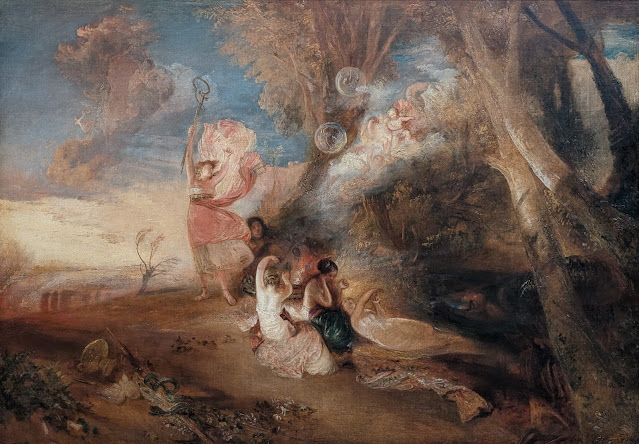
This painting was originally ridiculed. 

Medea is an epic character from Greek mythology. Having been rejected by the miscreant Jason, leader of the Argonauts; she decides to murder her own prepubescent children to spite her cheating husband. This has to be one of the most cruel and wicked action in a mythological tale. The enchantress sets free a snake (behind the tree in the darkness) on the children.

The painting was criticized as being too difficult to make out; and I have to agree. 

I don’t think this captures the evil of Medea.

✲✲✲

View of Orvieto, Painted in Rome by J.M.W. Turner (1828)

This is quite pleasing, but not as captivating as the others. I feel like there’s something missing here. Perhaps too much enveloping darkness. It gives the painting a shade of gloom and obscurity which has the effect of concealing. The two women are bathed in radiant sunlight, perhaps from the opening in the trees. Washing clothes.

Painted in Rome 1828. Turner passed through Orvieto on his way to Rome.

(A suggestively clad voluptuous lady in the sunshine?)