Sunday, July 9, 2023

Cherry Hinton Hall Park in Cambridge

I've been to Cherry Hinton Hall Park a few times this year. It's a small suburban park which is a lovely place to perambulate 

It has a small lake with a variety of common birds and a pair of swans. Lots of woods and a meandering rivulet, mature trees, and always some cute squirrels.

The entrance

Feeding the ducks, perhaps too much.


So beautiful, peaceful, reposeful ... Some lovely spots for some nature photography. I hope to take a few more photos before returning to London.


Hedge bindweed.

Heading for one of the exits ...

Feels like a John Constable painting; the unruffled tranquility and calmness. The reflection of the branches is so beautiful.


And heading to the shops for groceries.

Hopefully, I'll take photos of the swans next time.

Saturday, July 8, 2023

Review: On Liberty by John Stuart Mill

I've recently finished reading 'On Liberty' by Mill. Every few years I find myself re-reading this book. I profoundly agree with Mill, and spend most of the reading experience either nodding my head in agreement or shaking at some irritation alongside Mill. 

Originally published in 1859, it is an perceptive analysis of the human condition with regards to our thought-process and the way we treat others who stand in opposition to the consensus.

When I first read 'On Liberty', I remember finding the prose rather turgid - if not verbose; but I've now come to really enjoy his literary style. Mill has a lovely literary style - which makes me feel he's speaking and narrating. His otherwise discursive narrative obscures the concision with which his forceful philosophical points are couched. Indeed, so much so, that the book is immensely quotable. This is not a treatise, instead it takes the form of an extended essay and relates to his general utilitarianism ideology. I think its the brevity of 'On Liberty' which imbues it with its enduring aphoristic quality.

Core arguments

Mill argues that people are accustomed to believe that their "feelings are better than reasons" and that tolerance only operates as a prisoner's dilemma type of situation. So natural to humankind is intolerance that its only when the cost of philosophical or political quarrels becomes costly, that a truce of-sorts prevails: "the duty of toleration is admitted with tacit reserves". 

The preservation of liberty entails limits on government action. But, as I write this, I feel some despondency. Our world is radically different to Mill's account - most conspicuously during covid-19. So much so, that reading Mill feels, to me, rather quaint. Today, government is viewed - not with any suspicion - but with an air of an expectation. The expectation of intervening in almost every issue and to 'deal'  with every 'crisis'. Governments are expected to furnish solutions to all aspect of life - even the insoluble one. At least Mill's era involved some inherent realisation as to the limits of government. Nevertheless, Mill writes that "the only purpose for which power can be rightfully exercised over any member of a civilized community, against his will, is to prevent harm to others". This outlines his classic harm principle: "his own good, either physical or moral, is not a sufficient warrant" to exercise power over him.  But, the concept of what amounts to harm, more often than not, is precisely a person's own good (with the difference that today, it is repackaged as the well-being of others).

Nevertheless, as a starting proposition, he argues that people should be able to determine their own lives as it suits their characters. He presents four classic arguments.

1. Firstly, as a result of own non-infallibility, I have no more rational weight to impede the expression of opinions contrary to my own – than they would have to impede my own opinion. That is true of homosexuality, racism, prostitution, transgenderism etc. as being acceptable. As a matter of first principles, a person has no more rational weight for finding it acceptable than someone else holding the contrary. It is simply a point of view which is often held very strongly to such an extent that disagreement is automatically deemed as being 'wrong'. Mill argues that our infallibility ought to make us rein in the stifling of opinions that do not mirror our own - often the regnant orthodoxy. In so doing, Mill argues that humanity would be hurting itself. He says: "they have no authority to decide the question for all mankind, and exclude every other person from the means of judging". He argues eloquently that depriving a counter-position involves humanity losing "the clearer perception and livelier impression of truth".

2. Secondly, we have a duty to form our own opinions on subjects in life. To that extent, it is cowardice to withdraw and recoil from meaningfully acting on our earnest opinions. "People, in less enlightened times, have persecuted opinions now believed to be true", and it makes all the difference between assuming the truth for lack of refutation and not permitting its refutation. 

In my view, Mill touches on a deeply held insecurity often lurking beneath the surface vis-a-vis the censorious; namely, their anxiety about being challenged. Mill argues that a confident opinion ought to involve a "standing invitation to the whole world to prove them unfounded".

Mill rebukes the perceived impiety that may surround some given opinion; i.e. by "preventing the opinion from being heard in its defence, he assumes infallibility". He cites Socrates and the putative impiety of challenging the gods of the state and as the 'corrupter of the youth'. He cites Calvary, and the Sanhedrin putting Christ to death in genuine outrage at his impiety. The greatest harm, he says, is the reasoning that is cowed for fear of heresy. Truth gains more by people who earnestly think for themselves than those who "suffer themselves to think". An atmosphere of mental slavery. Without challenge, opinions morph into a "dead dogma, not a living truth". Its comprehension and rationality will wither, and any heartfelt and earnest conviction becomes a luxury. Elsewhere he argues that an aspect of individuality is originality, otherwise "human life would becomes a stagnant pool". As such, he reminds society that we should encourage people who think differently.

My own university boasts a world renowned status; and yet, last year, Kathleen Stock and Helen Joyce were abused and attempts were made to silence them and prevent fellow students from hearing their opinions. Mill's stagnancy seems fitting.

3. Thirdly, quoting Cicero, "he who knows only his own side of the case, knows little of that". By throwing ourselves into the mental position of those who think differently, we may overlook refining the truth. Referring to the Socratic method, he makes clear an obvious point which is that any prevailing orthodoxy is rarely the whole truth. It is via the collision of adverse opinions on which truth is ultimately furnished. He says quite beautifully:

If there are any persons who contest a received opinion ... let us thank them for it, open our minds to listen to them, and rejoice that there is some one to do for us what we otherwise ought.

This line is almost utopian. Have we ever lived in a world in which opinions are vigorously and honestly contested? Our opinions are tribal and held for the sake of vanity or peer-pressure. I really don't think we are a species that can think for itself. As much as I admire and love Mill's book, I increasingly feel that our culture would mock these points and, to that extent, it feels irrelevant to our world. There feels like an ever concentrated set of social and cultural orthodoxies; and against which, diversity and tolerance are regarded with suspicion and hostility. 

4. Finally, Mill cautions us from "stigmatising those who hold the contrary opinion as bad and immoral men". Mill argues that this argument is one-sided; i.e. the side with the comforting majority. The minority cannot attack the prevailing consensus as immoral or wicked etc. Similar to the ad hominem, Mill urges readers to restrain vituperation and such offensive attacks. On the other side, he cautions the minority position.

He argues that the expression of ideas is not without consequence or cost. By insulting a man's mother, I cannot expect or demand no consequences. A person who articulates an unorthodox or heretical view must be mindful of the way they comport themselves. They cannot demand no cost.

The liberty of the individual must be thus far limited; he must not make himself a nuisance to other people.But if he refrains from molesting others in what concerns them, and merely acts according to his own inclination and judgment in things which concern himself, the same reasons which show that opinion should be free, prove also that he should be allowed, without molestation, to carry his opinions into practice at his own cost.

Conclusion

There are some interesting tangential points. Mill seems to adopt a Lockian conceptions of rights which is qualified vis-a-vis children (up to the legal age). Liberty is defined negatively by 'failing to help his brother'. I am quite pleased to see Mill discounted the fanciful notion of the 'social contract' and maintained some, admittedly vague, conception of mutual responsibility between individuals and the community. These sentiments reflect an approach to liberty that deserves its own post. Moreover, there was a fascinating remonstration against Christian precepts which I quite enjoyed and may need to be fleshed out and analysed in more detail in a future post.

Ultimately, this is an excellent work which distills the need to acknowledge the flourishing of individual dignity through the liberty of the individual.

Friday, July 7, 2023

Turner at Tate Britain – Turner’s Seascapes – Part 3

Edit: This is a continuation of my chronicling the Turner gallery at the Tate Britain.

✲✲✲

These paintings by Turner are part of his unfinished works - which were discovered after his death - and concern his enduring fascination with the seas’s dazzling translucency, and its transient and dissolving movement. 

Norham Castle, Sunrise by J.M.W. Turner (1845)

This masterpiece of Norham Castle is fascinating and engrossing, and so very beautiful. I had it on my wall opposite my table while studying at Cambridge. I think it puts a smile on my face.

This feels like an early morning walk; when the misty river is illuminated by the radiant morning sunlight. A river which has become shallow enough for cows to stand in. The contrast between the yellow and blue highlights the castle and the rising sun.

Turner’s water has a mystic deep quality to it. The charming atmosphere - through the blazing refulgence of sunshine - seems to bounce of the surface of the landscape and subsume the canvass. Turner’s brushwork creates an evanescent ethereality to the water. As though, if I were to reach into the painting, it would turn into a misty foggy moistness. I love how the cow bears a reflection in the water which gives the painting a feeling of tranquil calm.

I see why people regard Turner as having laid down the foundation for impressionism and abstraction.

✲✲✲

Shipping at the mouth of the Thames by J.M.W. Turner (1806-7)

Shipping boats off the Thames Estuary.

A gentle breeze this time, and the direction and position of the shipping boats as they navigate the choppy waters looks quite clever. It does feel consistent with the bouncing seas. The sky looks unfinished; but it also looks like a storm if coming and will soon envelope the whole sky.

Again, I think this is delightful.

✲✲✲

A ship aground, Yarmouth by J.M.W. Turner (1827-8)


A painting intended for the Earl of Egremont.

This painting is really enchanting. I love the way Turner’s waves have an amazing curved shape that strectches back into the distance. The abandoned ship is positioned in such a way as to look as though it ran aground on rocks.

The stress and hazard of the disturbed vessel is counterposed with a very calm and placid sea. The sun is setting and the clouds seem to be coming over the horizon. What’s surprising is that this painting is apparently incomplete. I don’t think it needs much more.

✲✲✲

Breakers on a flat beach by J.M.W. Turner (1835-40)

According to the Tate, Turner may have made this painting in Margate. He may have travelled from London via steamboat.

I love the dark swirling pool of blackness at the bottom; and I like the way the two pillars of billowing darkness are rising. It feels like the edge of a forest at the banks of some river. I also like the patches of blue skyline at the top that are irradiated by Turner’s sunshine.  It’s a shame this wasn’t completed. There’s a hint of some appendages at the bottom-right corner?

✲✲✲

A wreck, with fishing boats by J.M.W. Turner (1840-5)

The skyline is probably incomplete. But somehow it seems to work quite well.

The water seem to have a similar  texture and movements to the sky. You can just make out two people on their boat. It’s quite pretty.

✲✲✲

East Cowes Castle, Regatta Starting for Their Moorings No. 3 by J.M.W. Turner (1827)

According to the Tate, this painting probably depicts a race. 

The tranquil water and irradiant sunshine floods the painting to create an aureate autumnal feel.

✲✲✲

Yacht Approaching the Coast by J.M.W. Turner (1840-5)

An unfinished painting. 

Feels like a journey through life, the pulsating etherality of the sunshine, has a dazzling effect.

Once again, I find this mesmerising. 

Monday, July 3, 2023

Review: The War of the Worlds by H.G. Wells

I really enjoyed reading this classic.

What is incredible is how someone from Victorian England could have contrived such a gripping modern sci-fi. The prodigious story is knotted together through Wells' inspiration, ingenuity and the intensity of his plot. Most of the novel depicts the narrator's anxiety to locate his missing wife, against whom he had been unintentionally separated at the outset. This makes for a pleasing ending. Otherwise, from the unnerving horror of the martians to the depths of human despair; I felt Wells really takes us on wild ride (his favorite word in the novel being 'tumultuous').

My first exposure to The War of the Worlds is the Steven Spielberg and Tom Cruise film which I thought was a terrific film. What is particularly striking is just how faithful that blockbuster was to Well's masterpiece.

Written in the style of a narrated diary, I was drawn to his plight, alienation and weariness. Wells gives us some deep reflections on the broader plight of mankind. For example, I really enjoyed the subtle intuition that the protagonist says to a clergyman - who having survived the initial annihilation - who starts beseeches 'what sins have we done?'. The response:

"You are scared out of your wits! What good is religion if it collapses under calamity? Think of what earthquakes and floods, wars and volcanoes, have done before to men! Did you think God had exempted Weybridge? He is not an insurance agent."

Haha. Love it. One of the most misconceived aspects of the monotheistic religions is the latent assumption that the natural world - from weather conditions to tectonic activity - occurs specifically for and about us, as its subject. But, stepping back, and looking at the natural world and physical laws that govern it; one gets a radically different perspective. Instead, death and suffering is the norm; and a part of everything. Life is a constant struggle of survival, and even stars die. I think Wells taps into a serious misunderstanding people have about death and our perception of ourselves in the world. He is fond of evoking the image of hapless bees and ants being massacred, or rabbits facing a bulldozer, or a rat scurrying. What is the point? I think Well's wants us to pity those suffering who are different from us:

I, who had talked with God, crept out of the house like a rat leaving its hiding place ... Perhaps they also prayed confidently to God. Surely, if we have learned nothing else, this war has taught us pity—pity for those witless souls that suffer our dominion.

Then, I was struck by the convulsions in the story to the moral and psychological effect that the nightmare bears on the individual as well as the masses. The fleeing throngs of people is starkly depicted with an almost Biblical quality. London's population is fleeing northwards along cramped narrow roads amidst an eclectic miscellany of social classes, unanimous in fear, torment & hunger.

There's a cheerless incident involving a desperate man - in the midst of a marching throng - lunging to retrieve a heap of coins he had dropped. He narrowly avoids being crushed under a horse's hoof; only to hear a scream as the wheel passed over the poor creature's back. Thus, back-broken, he is then positioned at the side of the road still clutching his coins. In the film, there is a similar scene involving gunshots for the sake of a car.

Then, there are also the imaginative and inventive analytical details of clinical horror which are fascinating. For instance, incandescent heat-rays, poisonous black smoke, or that the martians are said to inject their 'food' into the blood streams (circumventing a digestive system). Similarly, the martian's reproduction process is some mitosis-like splitting into twos. Then, there is the suggestion that natural selection favoured a steady diminution of the martians nose, teeth, ears etc in favour of the brain. Immediately afterwards, the protagonist even wonders if "the Martians may be descended from beings not unlike ourselves". 

It's also interesting that the martians are eventually slain by the humble Earthly bacteria - and not some machinery or science, human intelligence or strength, or even divine providence. Even in the demise of our foe, humankind is rendered impotent and useless. I find that ending resonates with me. I think it speaks to the reckoning that chance and randomness ultimately bears on our continued existence in the solar system. The harsh reality that we are not in control.

Sunday, July 2, 2023

Basilica of Our Lady of Good Health, Venice

Note: I originally visited Venice in July 2022; and then immediately afterwards started my degree at Cambridge. Having finished that degree - and now having some free time this summer - I plan to go through my archive and revisit it all for this blog.

✲✲✲

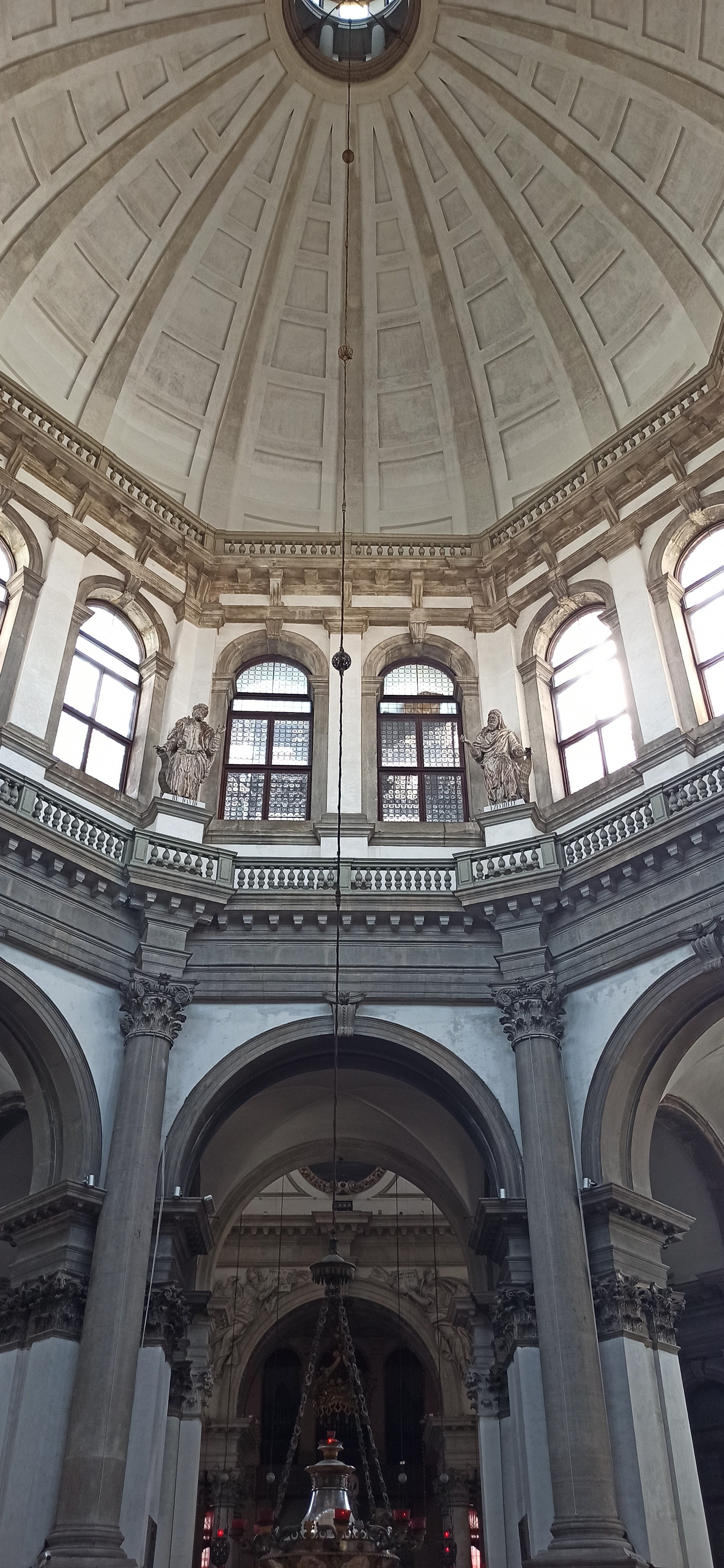
For me, this Basilica (Basilica di Santa Maria della Salute) was an absolute delight; bewitching and captivating. This beautiful silhouette had already been imprinted onto my mind through Turner; and so I was delighted to visit this Baroque paragon.


The Basilica of Our Lady of Good Health is in the Dorsoduro district of Venice. It's situated at the mouth of the Grand Canal and is responsible for the imposing iconic Venetian silhouette visible from the San Marco waterfront. It was dedicated to the Virgin Mary and commemorates the 46,000 Venetians who died in the second plague that began with the Black Death around 1631. It took 50 years to complete. 

The first thing to say is that it is thriving Catholic Church with worshipers usually in attendance. So, you have to be careful not to be too 'touristy' and respectful etc. Otherwise, there was a small fee. I was expecting to find it overcrowded, but it was very quiet and tranquil. As such, you could easily quietly appreciate its splendour and charm.


Next, it houses notable masterpieces of the 16th-century.

Luca Giordano, Presentation of the Virgin in the Temple.

Giordano's rendering of the classic painting of the Virgin entering the temple in Jerusalem aged three. You can see her in blue robes being blessed and welcomed. It's beautiful, as is the illusion of depth.

Luca Giordano, The Assumption of Mary.

Another Giordano. 

Luca Giordano, The Birth of the Virgin.

This alter-piece's subject is the birth of the Virgin overseen by angels in Heaven and the Almighty holding a globe. Baby Mary is surrounded by attentive and pretty girls kneeling. It's very graceful and stately.

Josse de Corte, The Queen of Heaven expelling the Plague.

This high-altar theatrical sculpture depicts the Queen of Heaven expelling the Plague. It was believed that the plague's abatement was attributable to the intersession of the Virgin Mary.

Titian Vecellio, The descent of the Holy Spirit.

Titian's painting of the descent of the Holy Spirit on the Apostles.

Pietro Liberi, St. Anthony Prays for Venice.

Last few photos on the wait out...